

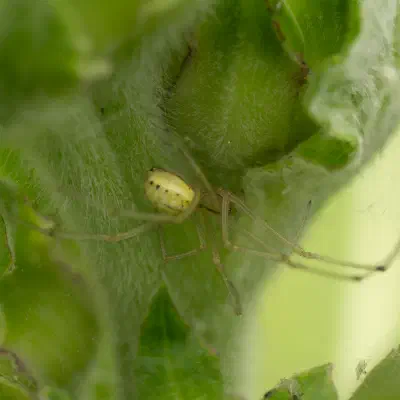

Webs
They often build tangle space webs, hence the common name, but Theridiidae has a large diversity of spider web forms. Many trap ants and other ground dwelling insects using elastic, sticky silk trap lines leading to the soil surface. Webs remain in place for extended periods and are expanded and repaired, but no regular pattern of web replacement has been observed. The well studied kleptoparasitic members of Argyrodinae (Argyrodes, Faiditus, and Neospintharus) live in the webs of larger spiders and pilfer small prey caught by their host’s web. They eat prey killed by the host spider, consume silk from the host web, and sometimes attack and eat the host itself. Theridiid gumfoot-webs consist of frame lines that anchor them to surroundings and of support threads, which possess viscid silk. These can either have a central retreat (Achaearanea-type) or a peripheral retreat (Latrodectus-type). Building gum-foot lines is a unique, stereotyped behaviour, and is likely homologous for Theridiidae and its sister family Nesticidae. Among webs without gumfooted lines, some contain viscid silk (Theridion-type) and some that are sheet-like, which do not contain viscid silk (Coleosoma-type). However, there are many undescribed web forms.


