Taxonomy
The Pimoidae are the sister group to the Linyphiidae.
There are six subfamilies, of which Linyphiinae (the sheetweb spiders), Erigoninae (the dwarf spiders), and Micronetinae, contain the majority of described species.
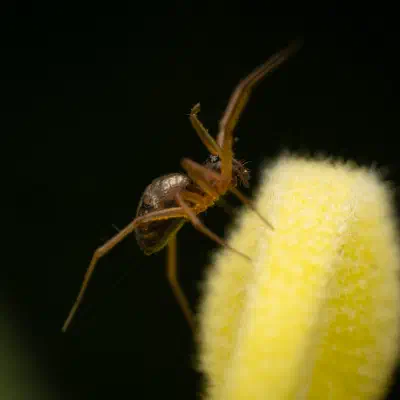
Many species have been described in monotypic genera, especially in the Erigoninae, which probably reflects the scientific techniques traditionally used in this family. Common genera include Neriene, Lepthyphantes, Erigone, Eperigone, Bathyphantes, Troglohyphantes, Tennesseellum and many others. These are among the most abundant spiders in the temperate regions, although many are also found in the tropics. The generally larger bodied members of the subfamily Linyphiinae are commonly found in classic “bowl and doily” webs or filmy domes. The usually tiny members of the Erigoninae are builders of tiny sheet webs. These tiny spiders (usually 3 mm or less) commonly balloon even as adults and may be very numerous in a given area on one day, only to disappear the next.
Males in the subfamily Erigoninae typically have modified cephalothoraxes. These modifications are diagnostic for a given taxon, being genus or species-specific. These come in an impressive array of forms including, but not limited to, grooves, tubercles, projections, bumps, lobes, and spines. Occasionally, the projections may be decorated with tufts of hair or even bear eyes.
The following are select examples of species in which males possess rather remarkable modifications. Walckenaeria acuminata has its eyes placed on a tall, thin spire whose height exceeds the length of the cephalothorax. Grammonota gigas has a transverse row of four longitudinal lobes behind the eyes. Gnathonargus unicorn has a long, slender, upward-pointing clypeal projection resembling a unicorn horn. Hypselistes florens has a cephalic lobe shaped like an hourglass when viewed from the front. Perregrinus deformis has a short, downcurved clypeal projection resembling a human nose. Praestigia kulczynskii has its anterior median eyes placed ventrally at the end of a long, thick projection issuing from the clypeus. The genera Coreorgonal and Spirembolus have their cephalic regions deeply divided into two pronounced lobes. Eskovia exarmata has a cephalothorax shaped like a trapezoid when viewed laterally. Horcotes quadricristatus has a single, sharp tooth sticking up between the anterior and posterior eyes.
Similarly, the pedipalps of males range from simple to complex in their design, with some possessing striking features and arrangements of palpal sclerites that are unique for a given genus and/or species.
A few spiders in this family include:
Bowl and doily spider, Frontinella pyramitela
Filmy dome spider, Neriene radiata
Blacktailed red sheetweaver, Florinda coccinea
Orsonwelles, a genus of giant Hawaiian Linyphids containing the largest Linyphiid, O. malus.
Erigone atra, a dwarf spider