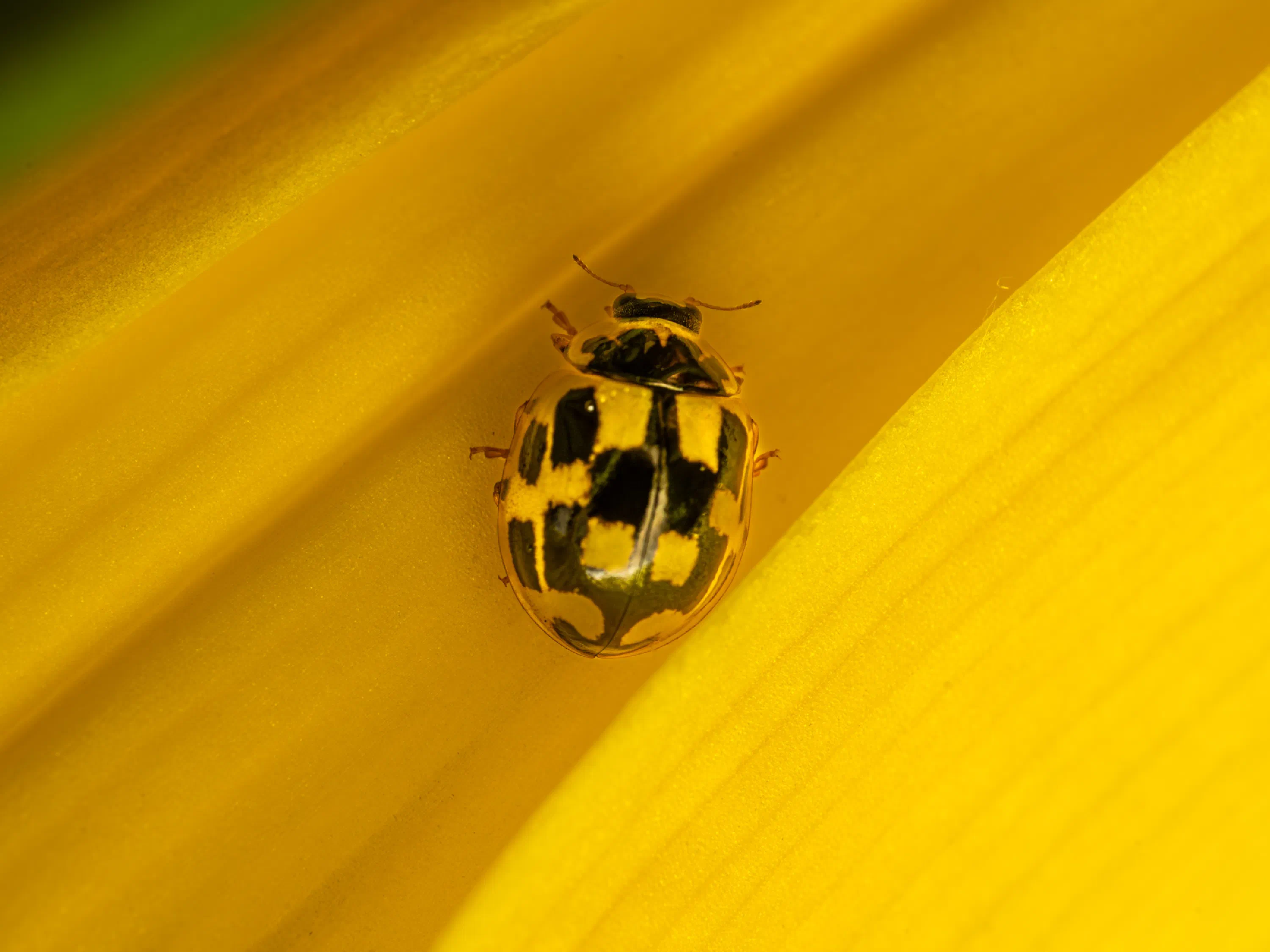
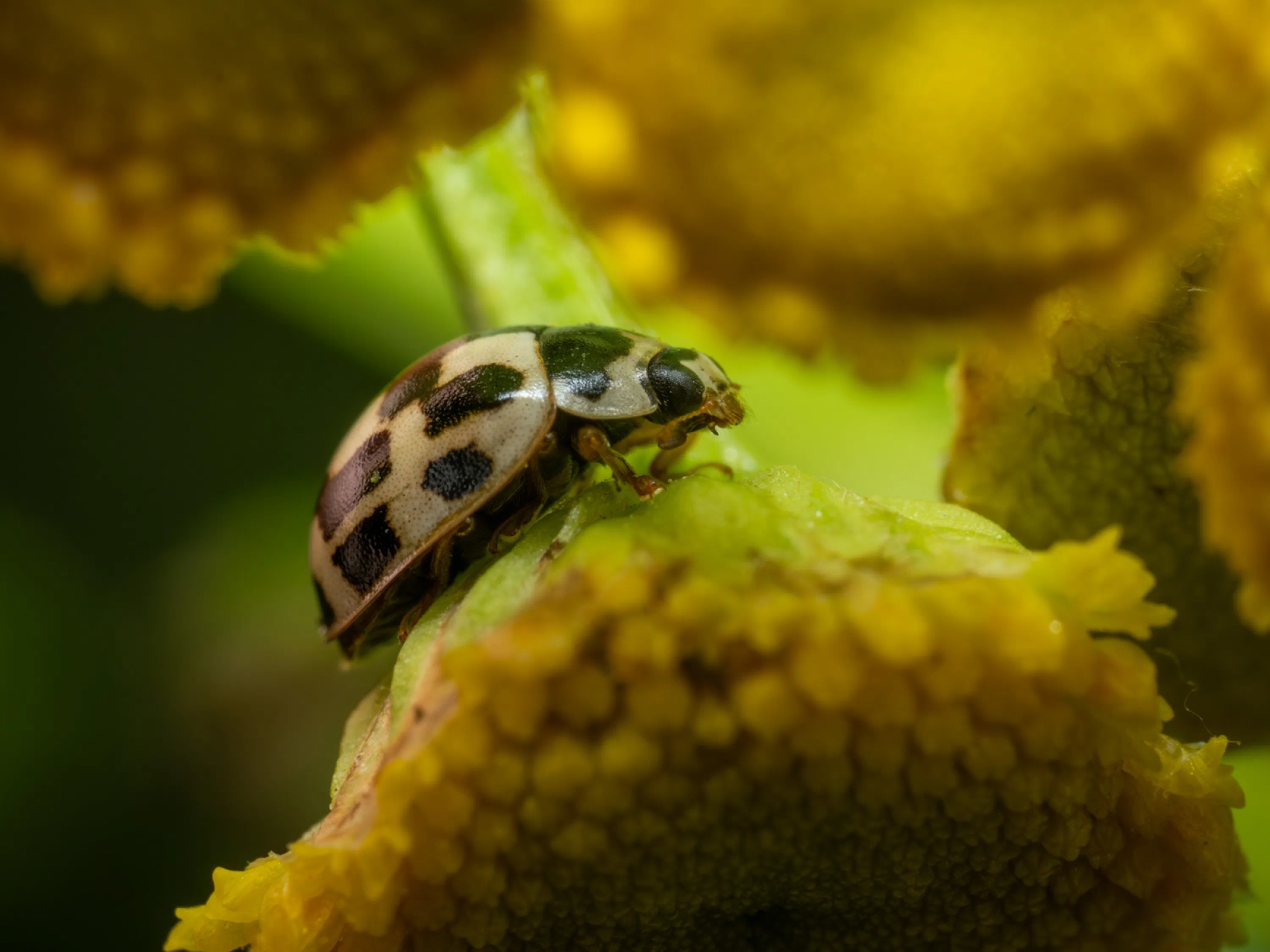
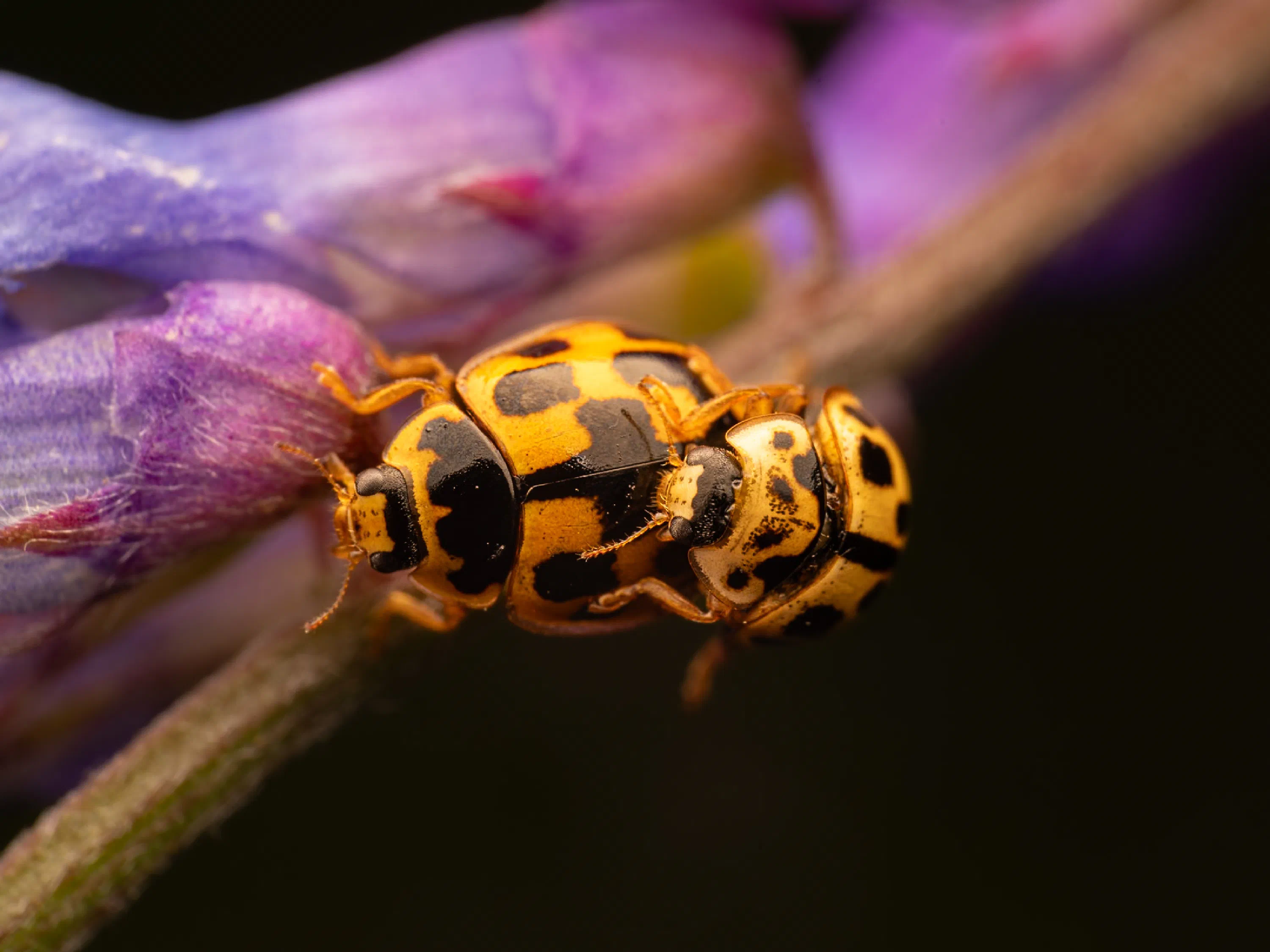
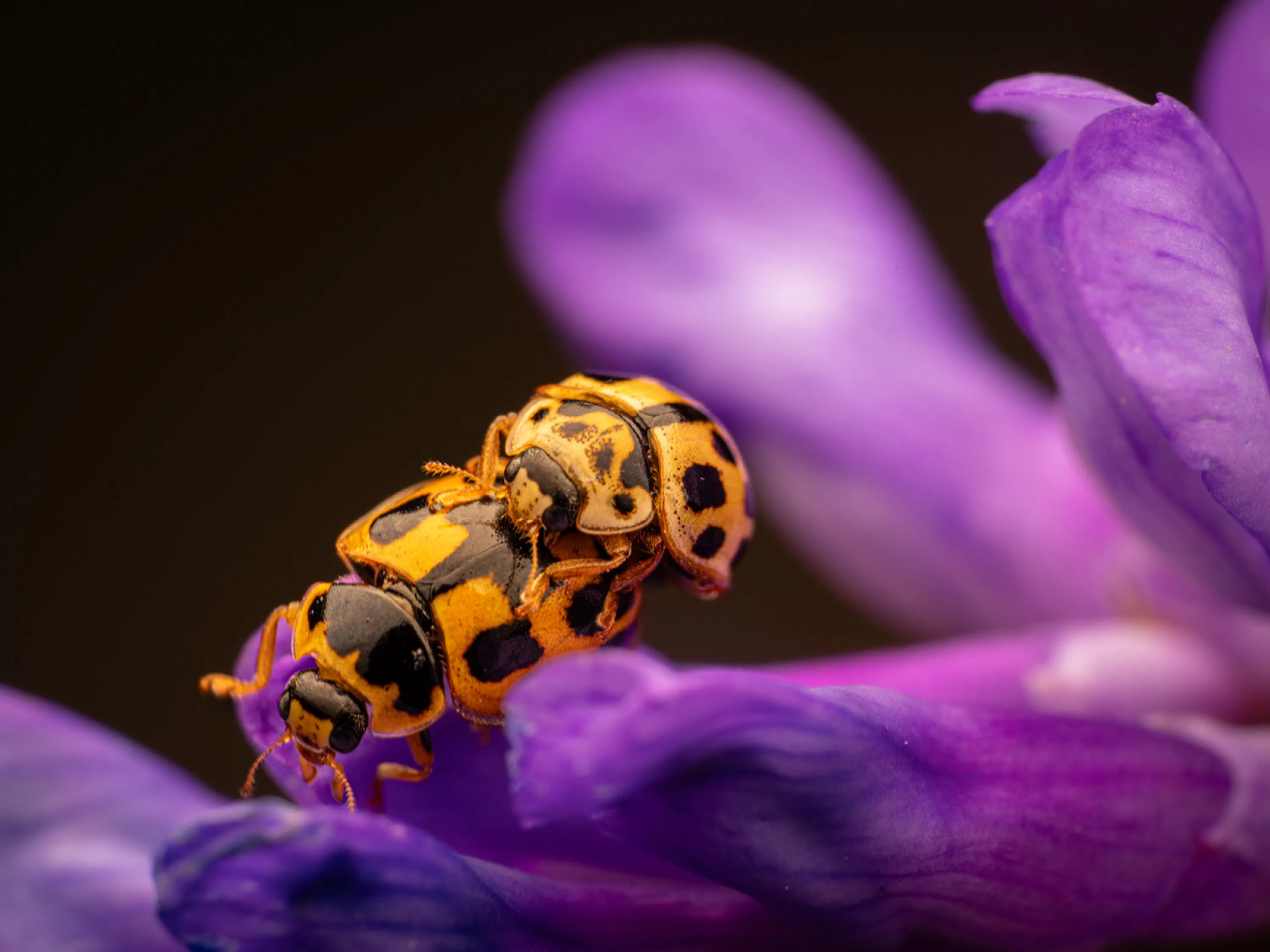
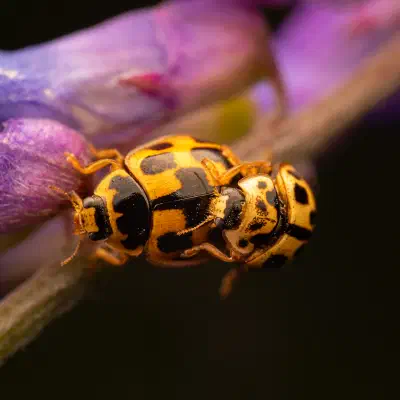
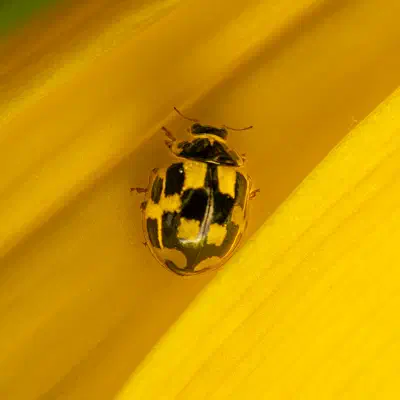
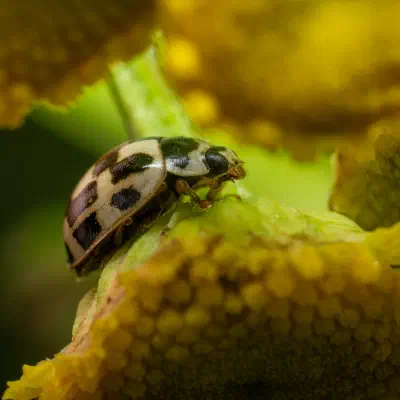
Fourteen-spotted Lady Beetle (lat. Propylea quatuordecimpunctata)
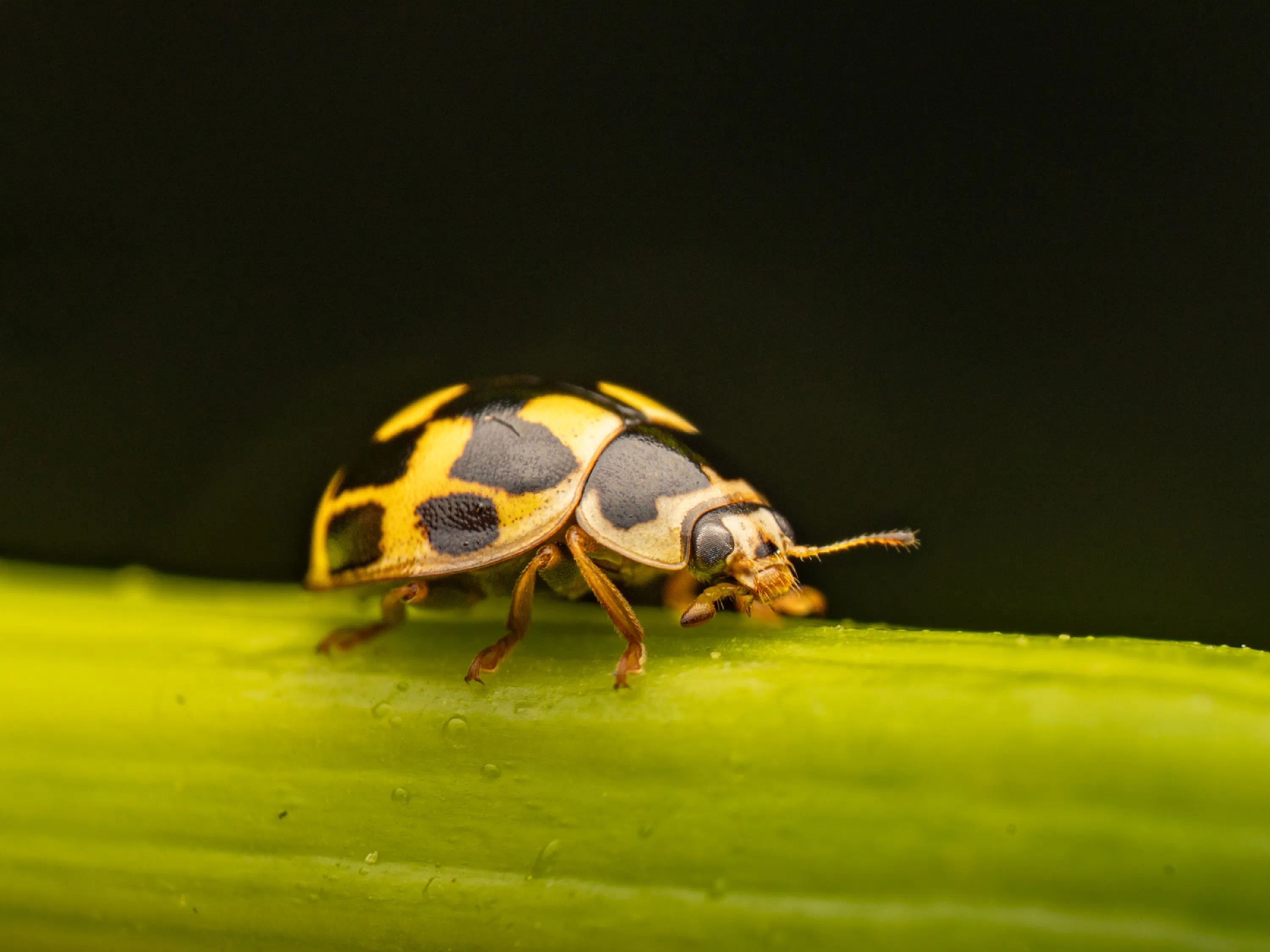
Fourteen-spotted Lady Beetle

Varieties

Varieties include: Propylea quatuordecimpunctata var. suturalis Weise, 1879 Propylea quatuordecimpunctata var. weisei Mader, 1931 Propylea quatuordecimpunctata var. pedemontana Della Beffa, 1913 Propylea quatuordecimpunctata var. frivaldskyi Sajo, 1882 Propylea quatuordecimpunctata var. pannonica Sajo, 1882 Propylea quatuordecimpunctata var. moravica Walter, 1882 Propylea quatuordecimpunctata var. perlata Weise, 1879

Copyright and source information
Fourteen-spotted Lady Beetle

Description

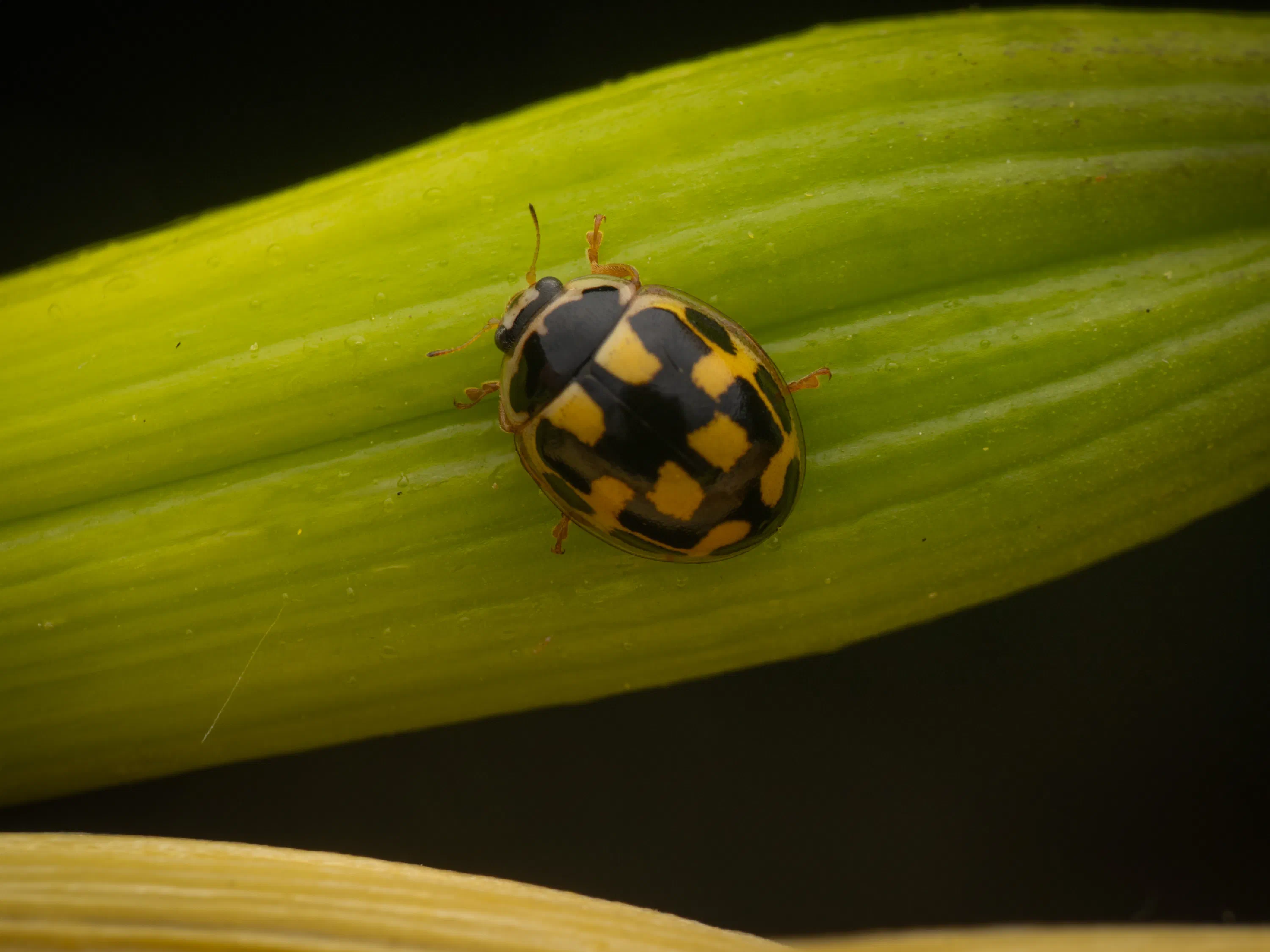
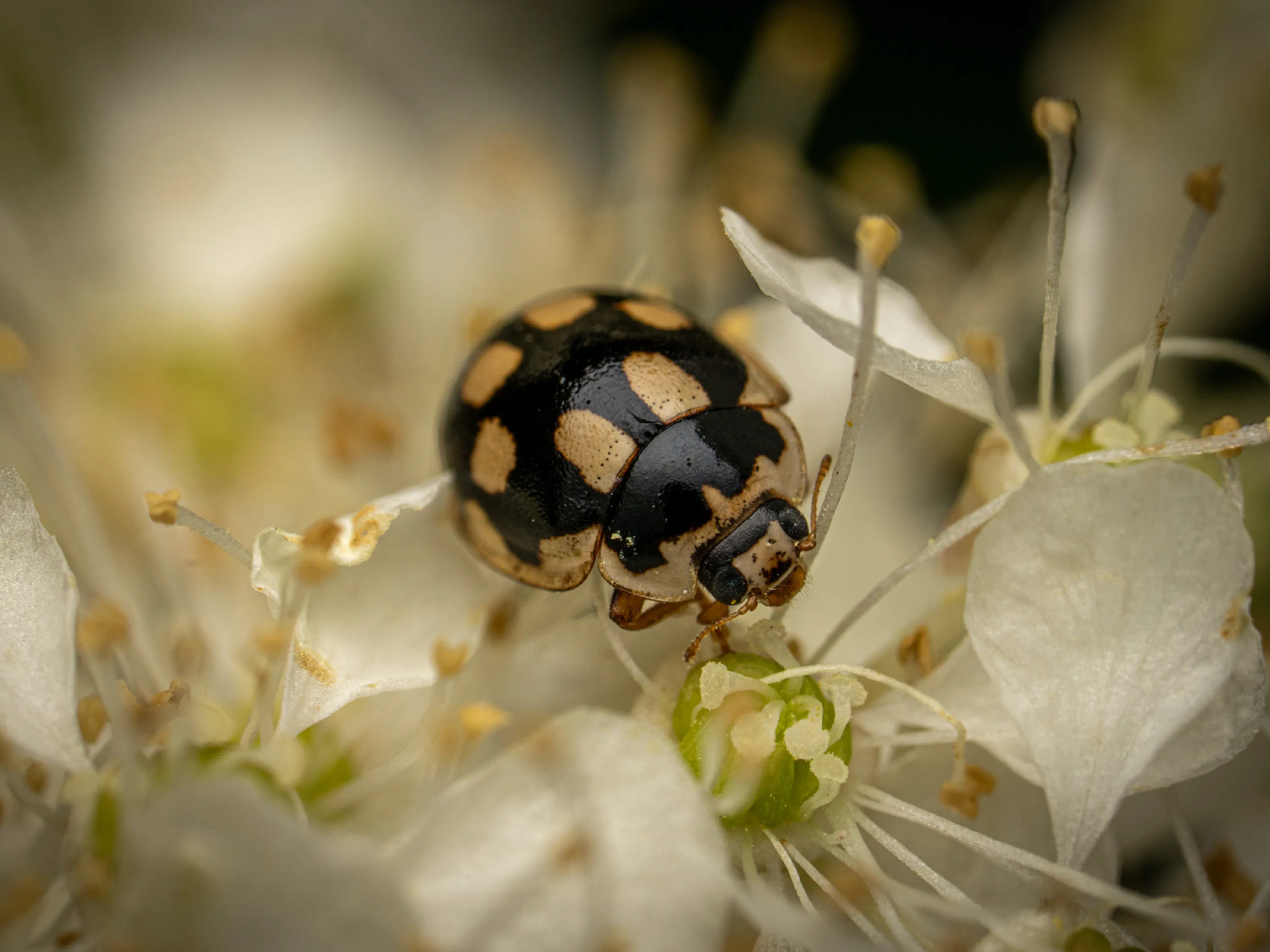
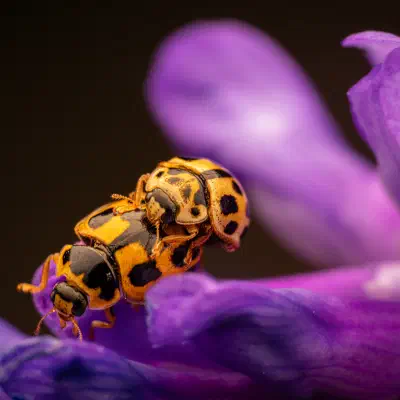
The beetles are 3.5 to 4.5 millimeters long, They have a great variety of color forms: well over 100 color and pattern variations. Some of these color forms differ to the extent that at first they were thought to be separate species. The background coloration ranges from cream through yellow to light orange, but not red. Usually there are 14 black, almost rectangular spots on the elytra, but only rarely are all of these spots separate

from one another. Most commonly, several of the spots are fused into larger markings, particularly along the midline, where they often create a shape resembling an anchor, sometimes fusing to such an extent that the yellow disappears almost completely, rendering the body almost entirely black except for 12 pale yellow spots. The pronotum is whitish or pale yellow, with four to eight black spots. The antennae and legs are yellowish-brown.

Copyright and source information
Fourteen-spotted Lady Beetle

Distribution

This species is native and widespread in the Palearctic north to the Arctic Circle. It is a common species in Europe, North Africa, Cyprus, European Russia, the Caucasus, Siberia, the Russian Far East, Belarus, Ukraine, Moldova, Transcaucasia, Kazakhstan, Western Asia, Pakistan, Mongolia, temperate China (Tarim Basin deciduous forests and steppe), Korea and Japan. The species is adventive and widespread in North America (southeastern Canada to the Great Lakes and Florida), and is

still spreading. The initial introductions of this species in the United States were intended as a controlling agent for the Russian wheat aphid (Hoebeke 2019).

Copyright and source information
Fourteen-spotted Lady Beetle

Habitat

These beetles live in numerous different habitats, from lowlands to subalpine areas (Prealps), and Western European broadleaf forests, mixed forests and meadows, as well as in fields, forests, and other Life zones of central Europe. They can be found in gardens and parks, on grasses and herbaceous plants, in bushes, and trees. In addition the species can be found in forest litter, on brushwood, on coarse woody debris, in moss, in straw in sheds, in

detritus and alluvial soil, in rotten plant residues, and also in compost.

Copyright and source information
Fourteen-spotted Lady Beetle

Biology

Propylea 14-punctata is entomophagous (insect-eating). It feeds on aphids, Aleyrodidae, Coccoidea, and on the larvae and eggs of some beetles and butterflies The females lay about 400 eggs; this is necessary as there is often a high mortality among the larvae. The adult beetles overwinter twice.

Copyright and source information
Fourteen-spotted Lady Beetle

External links

Media related to Propylea quatuordecimpunctata at Wikimedia Commons Data related to Propylea quatuordecimpunctata at Wikispecies Poorani J. (2004) – Annotated Checklist of the Coccinellidae (Coleoptera) of the Indian Subregion Helgard Reichholf-Riehm: Insekten. Orbis, München 1984. ISBN 3-572-01088-8 Harde, Severa: Der Kosmos Käferführer, Die mitteleuropäischen Käfer, Franckh-Kosmos Verlags-GmbH & Co, Stuttgart 2000, ISBN 3-440-06959-1 Jiři Zahradnik, Irmgard Jung, Dieter Jung et al.: Käfer Mittel- und Nordwesteuropas. Parey, Berlin 1985, ISBN 3-490-27118-1

Copyright and source information

This is not intended to be a dry lexicon. Personal stories and sensitive articles form the framework for our pictures: „Explained as easy as pie — the exciting adventures of ants“ Discover the fascinating lifestyles and adventures of ants in their well-organized colonies.

Full post

Explained as easy as pie — the exciting adventures of ants