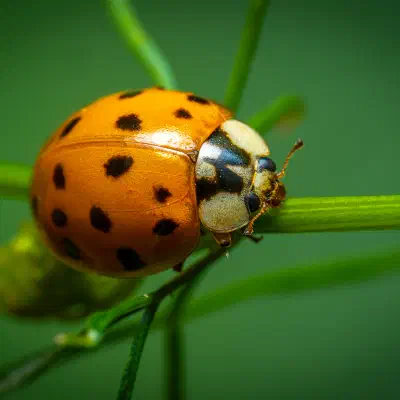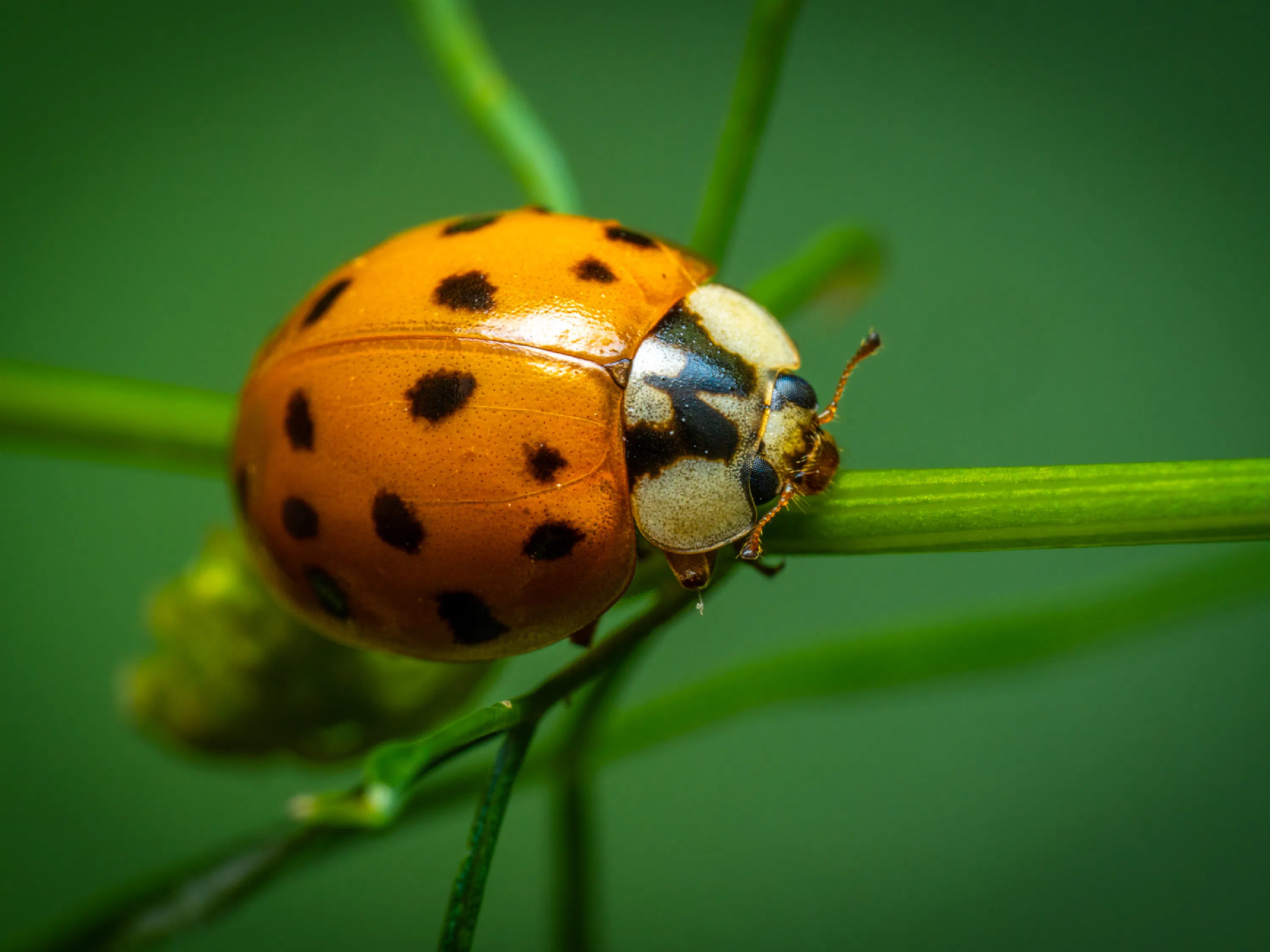
Water Ladybird (lat. Anisosticta novemdecimpunctata)

Water Ladybird
Water Ladybird

Description

The beetles are between 3 and 4 mm in length, with elongated bodies that are comparatively weakly curved. They have yellow, orange, to reddish to pink-colored elytra that display 19 black spots. On the beige to yellow scutum are also six black patches that can be connected to each other through ridges. The variability is lower than in other species. Patches are seldom connected or absent. The legs are yellow, and the feet and claws

are somewhat slightly darker. The elytra are spotted and finely-grained in between. The claws are untoothed.
Copyright and source information
Water Ladybird

Biology

The habitat in Central Europe is wetlands- fen grassy marshes, forested swamps, and peat bogs and mires. They are found on marsh- and water-plants such as reeds (Phragmites spp.), sedges (Carex spp.), sweet-grass (Glyceria spp.) occasionally also on willows (Salix spp.), where they feed on aphids. The species also occurs on steppes (Pontic–Caspian steppe, Pannonian Steppe), birch outliers and on moor and bog edges. It also feeds on Erysiphales fungi on Gramineae and Compositae.

Copyright and source information
Water Ladybird

Distribution

The species is common in the West Palearctic-Europe, and is found in the north up to southern Norway, central Sweden and Finland and into European Russia (middle zone and the south). In England and Ireland., the Caucasus, Siberia, Kazakhstan, Middle Asia.

Copyright and source information
Water Ladybird

References

Jiři Zahradnik, Irmgard Jung, Dieter Jung et al.: Käfer Mittel- und Nordwesteuropas. Parey, Berlin 1985, ISBN 3-490-27118-1. Volker Nötzold: Marienkäfer, Bestimmungsschlüssel. Deutscher Jugendbund für Naturbeobachtungen 1997, ISBN 3-923-37620-0

Copyright and source information

This is not intended to be a dry lexicon. Personal stories and sensitive articles form the framework for our pictures: „Explained as easy as pie — How insects communicate with their environment“ Insects communicate in various ways, including pheromones, sounds, and visual signals, to interact with each other and survive.

Full post

Explained as easy as pie — How insects communicate with their environment