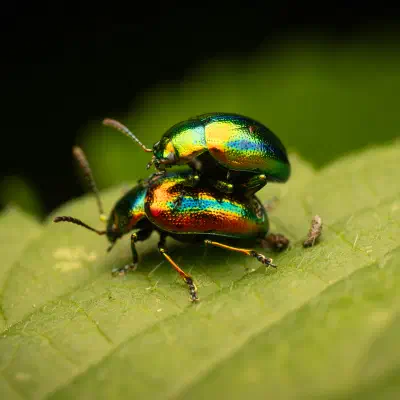
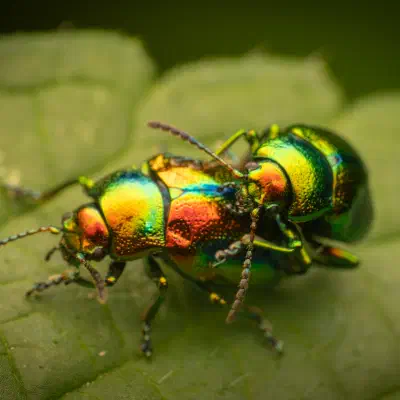
Dead-nettle Leaf Beetle (lat. Fasta fastuosa)

Dead-nettle Leaf Beetle

Description

The species has a length ranging from 5.1–6.9 millimetres (0.20–0.27 in). F. fastuosa has a gold shine that transitions to a green or violet-blue longitudinal stripe near the shoulder band of the elytra as well as near the suture. Occasionally, specimens of F. fastuosa may be completely green or black in colour.

Copyright and source information
Dead-nettle Leaf Beetle

Ecology

Adults and larvae of F. fastuosa feed on various plants in the family Lamiaceae, including hemp-nettle (Galeopsis) and dead-nettle (Lamium). It is also known from common nettle (Urtica dioica), which is in family Urticaceae. Adults and larvae graze on leaves, while larvae may also be found in fruiting calyxes. Larvae are parasitised by the tachinid fly Macquartia grisea.

Copyright and source information
Dead-nettle Leaf Beetle

Taxonomy

F. fastuosa was formerly classified in the genus Chrysolina, as the only member of the monotypic subgenus Fastuolina proposed by Warchałowski in 1991. Some authors consider the name "Fastuolina" to be an unavailable name under the International Code of Zoological Nomenclature, such as due to failure to comply with Article 13.1 as it was not accompanied by required text (or pointer to such text) that would differentiate the taxon. Hence later the new name Fasta

was proposed for the subgenus by Petitpierre and Alonso-Zarazaga in 2019. In 2023, a phylogenetic analysis based on DNA extracted from museum specimens recovered "C." fastuosa in a sister group relationship with the genus Oreina. These authors therefore raised the taxonomic rank of Fasta from subgenus to genus to reflect the uniqueness, resulting in the new combination Fasta fastuosa (Scopoli, 1763) for the species.

Copyright and source information
Dead-nettle Leaf Beetle

External links

Media related to Fasta at Wikimedia Commons Data related to Fasta at Wikispecies

Copyright and source information

This is not intended to be a dry lexicon. Personal stories and sensitive articles form the framework for our pictures: „We received a letter from a reader“ An angry butterfly has written to us. It's about a lack of respect for small beings and the failure to preserve nature and our planet.

Full post

We received a letter from a reader