



Overview
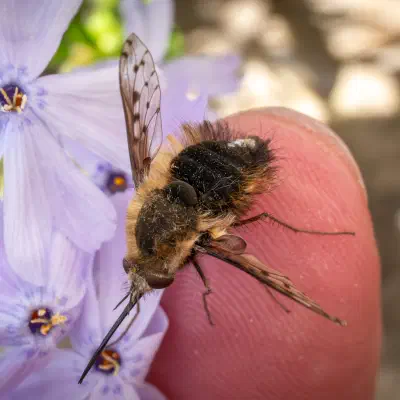
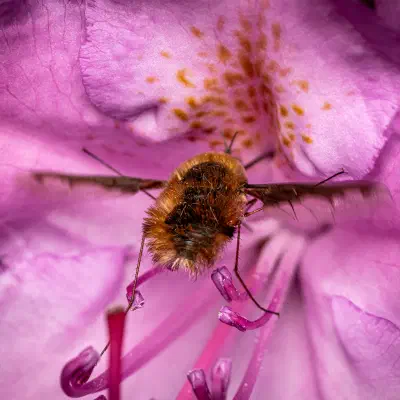
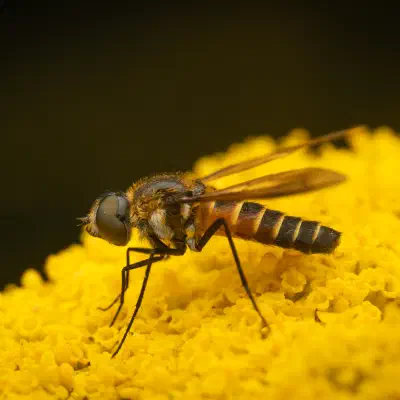
The Bombyliidae are a large family of flies comprising hundreds of genera, but the life cycles of most species are poorly known, or not at all. Their size varies between species ranging from 2 mm long to a 40 mm wingspan making them some of the largest flies. When at rest, many species hold their wings at a characteristic “swept back” angle. Adults generally feed on nectar and pollen, some being important pollinators, often with spectacularly long proboscises adapted to plants such as Lapeirousia species with very long, narrow floral tubes. Unlike butterflies, bee flies hold their proboscis straight, and cannot retract it. Many Bombyliidae superficially resemble bees and accordingly the prevalent common name for a member of the family is bee fly. Possibly the resemblance is Batesian mimicry, affording the adults some protection from predators. The larval stages are predators or parasitoids of the eggs and larvae of other insects. The adult females usually deposit eggs in the vicinity of possible hosts, quite often in the burrows of beetles, wasps, or solitary bees. Although insect parasitoids are usually fairly, often highly, host-specific, some Bombyliidae are opportunistic and will attack a variety of hosts. The Bombyliidae include at least 4,500 described species, and certainly thousands more remain to be described. However, most species do not often appear in abundance, and compared to other major groups of pollinators they are much less likely to visit flowering plants in urban parks or suburban gardens. As a result, this is arguably one of the most poorly known families of insects relative to its species richness. The family has a patchy fossil record, with species being known from a handful of localities, the oldest known species are known from the Middle Cretaceous Burmese amber, around 99 million years old.


