Trivittate Marsh Fly (lat. Helophilus trivittatus)

Trivittate Marsh Fly
Scroll to read on

Helophilus trivittatus is a Palearctic hoverfly.

Trivittate Marsh Fly – Etymology

Etymology

The scientific genus name is composed of the parts helos (ἕλος, gr.), meaning “marsh” and philos (φίλος, gr.) meaning “friend”. The species name is composed by “tri” (lat.), meaning “three” and “vitta” (lat.) meaning “band”. This name refer to the preference of these insects for moist areas and to the fact that they carry three stripes on the breast shield.

Trivittate Marsh Fly – Description

Description

For terms see Morphology of Diptera

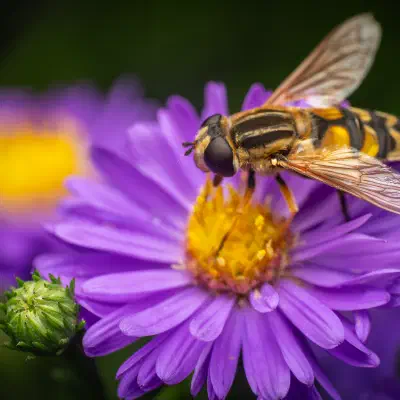
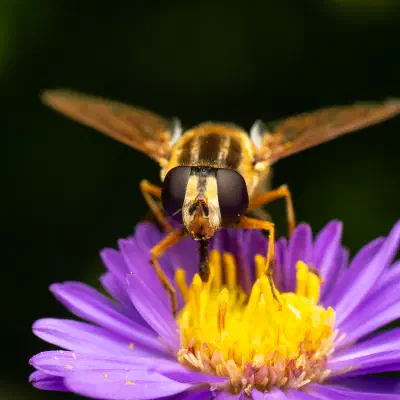
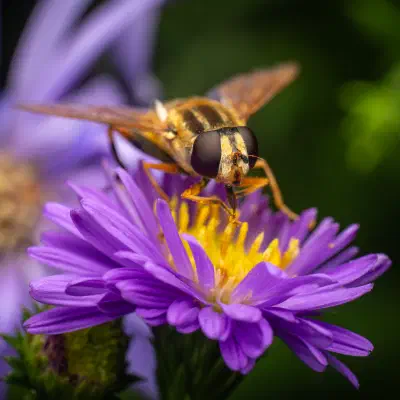
Helophilus trivittatus has a wing length of 10.25–12.25 millimetres (0.404–0.482 in). The eyes are separated in both sexes, in the male a little less than in the female. The antennae are black, Face shows a wide yellow longitudinal stripe, with at most a central reddish-brown stripe. On the thorax four narrow pale yellow stripes alternate with three larger dark brown stripes. The drawing of the flattened abdomen is reminiscent of a wasp. The drawing of the third and fourth segments of the abdomen is different in the two sexes. In the male, only the third segment carries a pale yellow to gray arc line. In the female, such a curve is found on the fourth and the fifth tergite. Tergites 2 and 3 have pale lemon yellow spots, while tergite 4 has white to grey spots. In the females tergite 3 yellow spots touch the front margin. The larva is illustrated by Hartley (1961) See references for determination.

Distribution

This species is present in most of Europe and in the eastern Palearctic realm. It is widespread from Fennoscandia south to the Mediterranean Basin, and from Ireland east through Europe, Siberia, and the Russian Far East to the Pacific. it is also present in Iran and Afghanistan. It has been observed migrating in Sweden.

Habitat

These hoverflies inhabit wetland, river margins, seasonally flooded grassland and salt-marsh. They are anthropophilic in southern Europe, where it frequents irrigation ditches in farmland.

Biology

The flight period of this species is from May to October. Adults feed on various flowers, including umbellifers, yellow composites, Armeria, Aster, Cakile, Centaurea, Chrysanthemum, Cirsium, Crataegus, Chamaenerion angustifolium, Eryngium, Eupatorium, Euphorbia, Ligustrum, Lychnis, Lythrum, Mentha, Menyanthes, Origanum, Plumbago, Polygonum persicaria, Potentilla, Ranunculus, Rubus fruticosus, Salix and Sorbus. The larva is a detritivore associated with decaying rhizomes of Typha latifolia and with beds of Glyceria maxima.

Ancestry graph

Arthropods Insects Brachyceran Flies Hover Flies Common Drone Fly Common Globetail Eumerus Hornet Mimic Hover Fly Marmalade Hover Fly Narcissus Bulb Fly Pellucid Hover Fly Pipizella Tapered Drone Fly Thick-legged Hover Fly Trivittate Marsh Fly Variable Duskyface Fly Yellow-bowed Smoothwing Yellow-haired Sun Fly

Copyright and source information

This project wouldn’t exist without Wikipedia and iNaturalist! As citizen scientists, we benefit enormously from the community’s shared knowledge. This article uses material from Wikipedia and iNaturalist. The images on this website are licensed under Attribution-NonCommercial-ShareAlike 4.0 International.

This article uses material from the Wikipedia article Helophilus trivittatus the free encyclopedia Wikipedia which is released under Creative Commons Attribution-ShareAlike 4.0 International License). On Wikipedia a list of authors is available.

This is not intended to be a dry lexicon. Personal stories and sensitive articles form the framework for our pictures: „The old man and the Chorthippus apricarius“ A melody amidst the great noise

Full post

The old man and the Chorthippus apricarius

Trivittate Marsh Fly – image 1
Trivittate Marsh Fly – image 2
Trivittate Marsh Fly – image 3