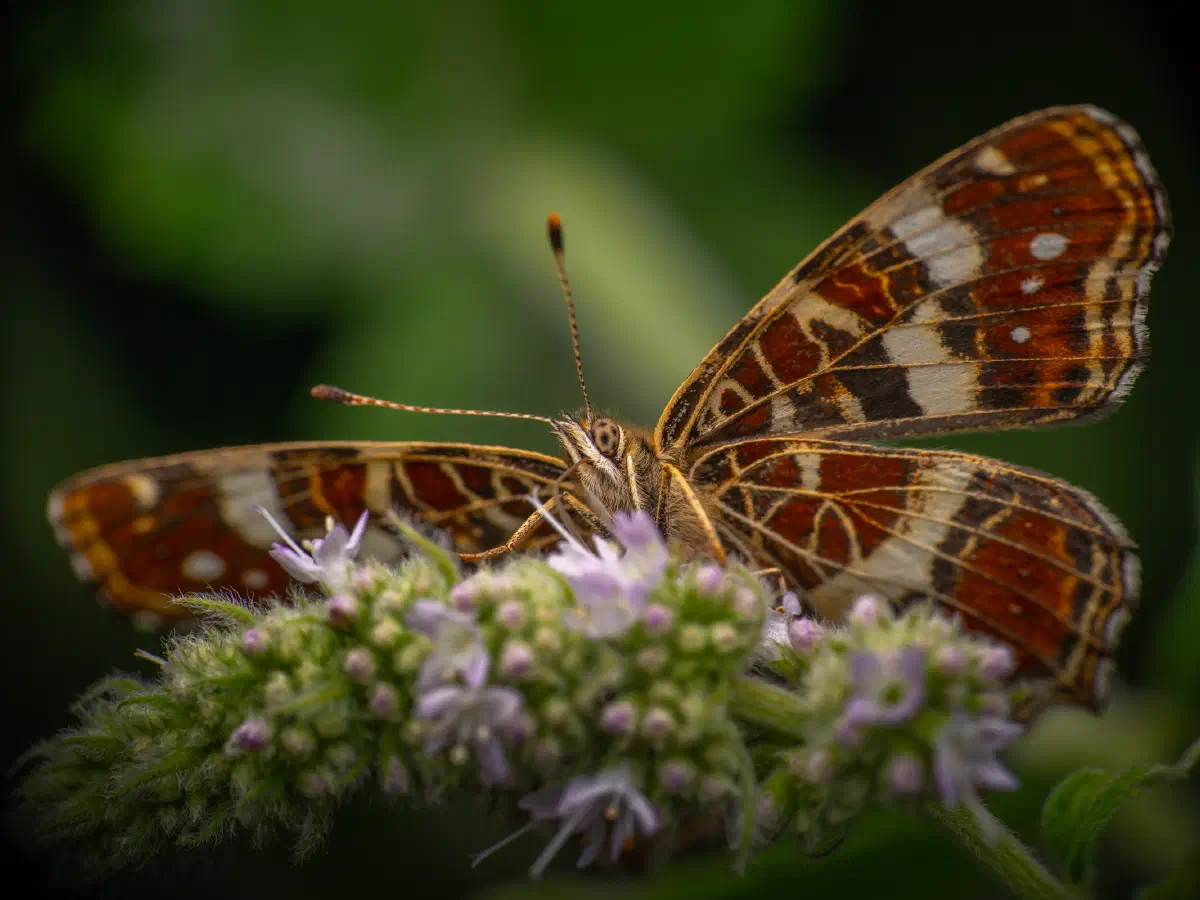
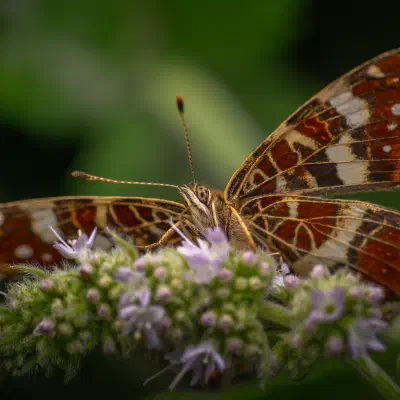
A. levana L. (64d) has on a reddish ochreous ground a characteristic pattern of spots, some whitish subapical and distomarginal spots on the forewing and a row of blue bars near the distal margin of the hindwing. The underside of the forewing on the whole agrees with the upper, but the apical area bears violet dusting, the ground-colour is paler, and there are sharply defined white lines at the cell-spots; the hindwing is for the
greater part red-brown, bearing in the centre a pale transverse band which widens behind, in places light lines traverse the wing and there is a dull violet smear in the distal area; the margin of both wings bears thin black lines. This is the first brood, which flies early in the spring (April–May). There occur among the ordinary form occasionally specimens in which the black basal and costal markings are confluent and both wings dark-margined,
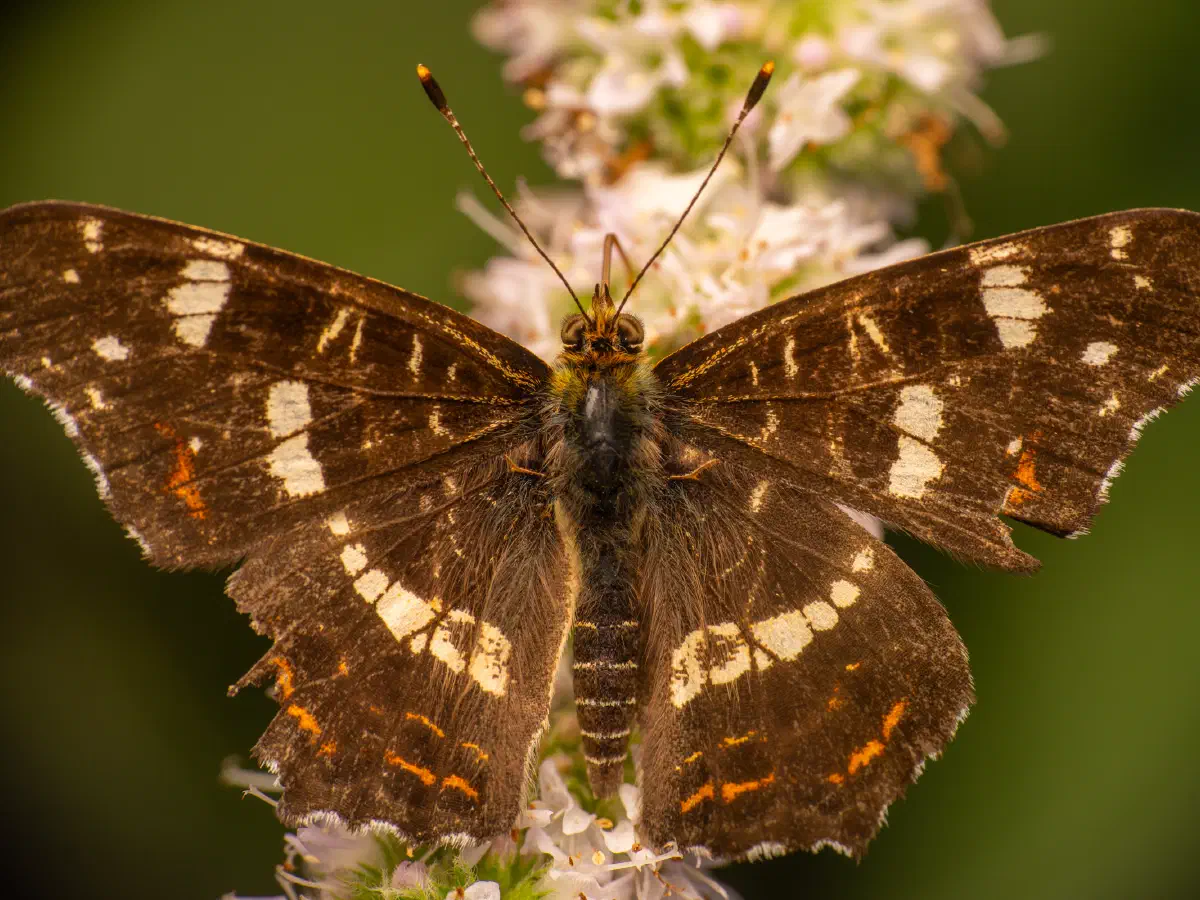
while the other markings of the wings (in the centre) are quite or nearly obsolete, these areas therefore being nearly uniformly red-brown. This is ab. frivaldszkyi Aigner. The summer-brood (July till August), sometimes also a third brood (September–October), is essentially different, being known as ab. prorsa L. (64d). Black, the forewing with white spots, the hindwing with a white transverse band; for the greater part red-brown beneath, with whitish lines and bands. On the upperside
there appear vestiges of reddish yellow lines at the distal margin; specimens in which these lines are absent or only in places slightly indicated, while the white markings are narrowed, are ab. obscura Fruhst. (64f). If the white marking is narrowed to a yellowish stripe, or if the hindwing is entirely black, the name ab. schultzi Pfitzn. may be employed. Specimens in which the upperside is entirely without white bands, the small spots in the
distal area being either present or absent, have been named ab. weismanni Fisch. (artificially produced). On the other hand, the individuals with the bands partly yellowish and the reddish yellow distal markings strongly developed may be named ab. intermedia form. nov. (64d); not rare in nature, being especially frequent in wet and cold summers. It forms the transition to ab. porima O. (64d) which is already so much changed in the direction of the spring-brood
that the reddish yellow colour in the distal area forms the ground-colour, the bands of prorsa, however, still being visible. Finally, ab. diluta Spul. is an artificially produced variety which resembles porima, but the forewing has an archaic Nymphalidian character in the row of spots recalling the ocelli found in the Satyrids. All these forms are connected by intergradations, prorsa being considered the more recent form, which can be changed by the application of cold
into levana (the ancestral form), while the inverse does not take place. — The egg of the species is ovate, flattened above, ribbed, of a greenish colour. The larva feeds on Urtica dioica gregariously; it is black or pale brown with black stripes, sometimes with a reddish side-line, armed with short branched thorns, which are black, sometimes yellow. Pupa brown, spotted with blackish, the projections of the head and back obtuse, sometimes with metallic spots.
The pupa of the last brood hibernates. The species is distributed over Central and East Europe (except England) southward to Dalmatia, through Armenia, Siberia, Amurland, Ussuri, Corea to Japan (here apparently in 3 broods), the varieties recurring in the East without showing any striking or constant differences from those of the West.