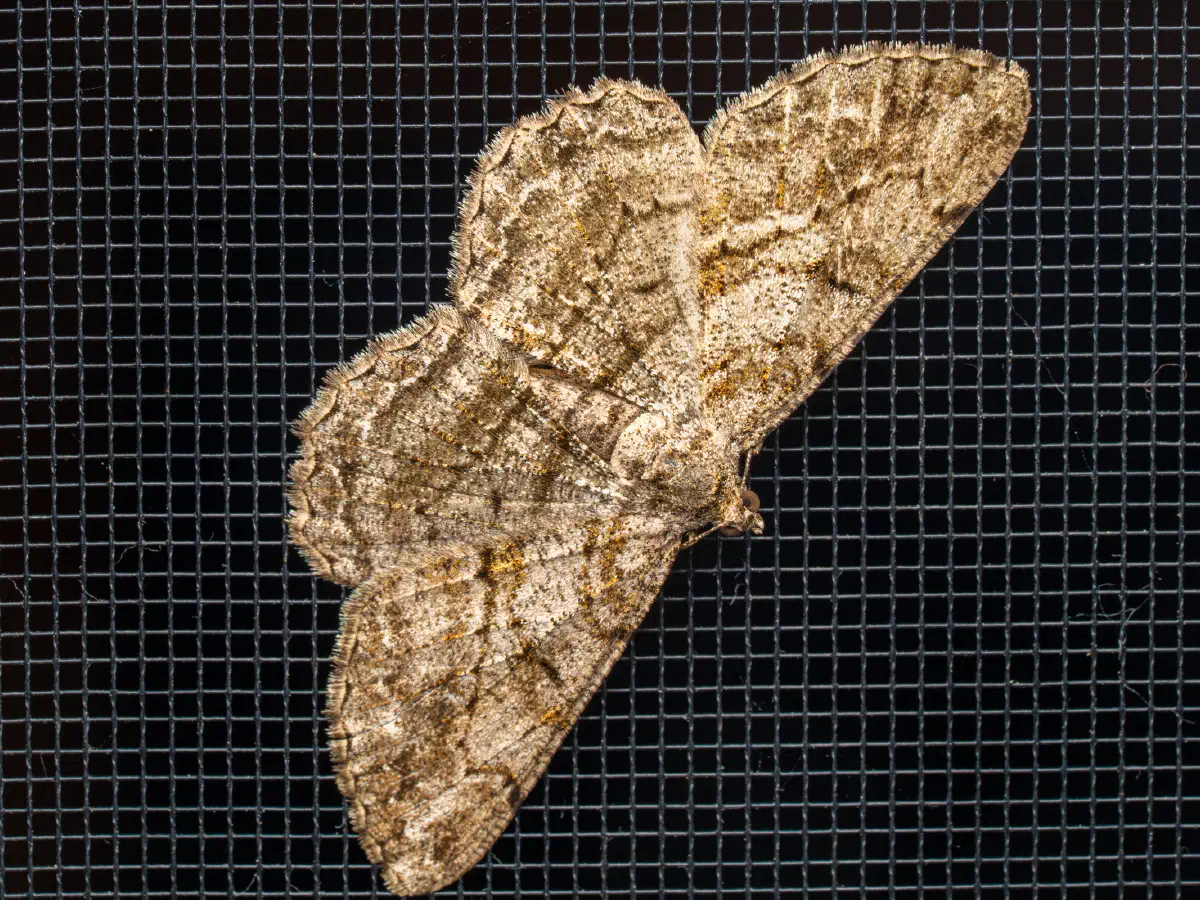
Willow Beauty (lat. Peribatodes rhomboidaria)

Willow Beauty
Willow Beauty

Description and ecology

The adult's wingspan is 40–48 mm. The wings of this species are whitish-grey or -yellowish, though they have a buff or grey appearance from a distance, as they are heavily speckled with brown or black dots. Running over the fore- and hindwings in a semicircle are the two blackish bands commonly found in Ennominae, but they are broken and somewhat indistinct in this species. A tell-tale characteristic is a single bulge in the forewing part

of the outer blackish bands. Melanic forms (e.g. rebeli) sometimes occur. The sexes can be distinguished by their antennae, which are strongly feathered in the male, but almost smooth in the female. See similar species (below) This moth inhabits woodland, gardens and similar habitat. Either one or two generations occur each year, depending on locality. The adults are on the wing during summer – e.g. June to September on the British Isles, while in the more

continental climate of Austria they are rarely seen anymore in late August. They fly at night and are attracted to light. The caterpillar larva is reddish-brown and feeds on a variety of trees and shrubs, but – despite its name – rarely or never on willows (Salix). The species overwinters as a small larva. As evidenced by the species distribution, it does not seem to tolerate severe and dry winters very well.
Copyright and source information
Willow Beauty

Synonyms

Junior synonyms of the willow beauty include: Geometra rhomboidaria Denis & Schiffermüller, 1775 Boarmia corsicaria Schawerda, 1931 Boarmia defloraria Dannehl, 1928 Peribatodes dragone de Laever & Parenzan, 1986 Boarmia psoralaria Millière, 1885 Boarmia syritaurica Wehrli, 1931

Copyright and source information
Willow Beauty

Similar species

Peribatodes rhomboidaria is difficult to certainly distinguish from its congeners. See Townsend et al. Peribatodes secundaria ([Denis & Schiffermüller], 1775) Peribatodes ilicaria (Geyer, 1833 Deileptenia ribeata (Clerck, 1759) Alcis repandata (Linnaeus, 1758)

Copyright and source information
Willow Beauty

References

Chinery, Michael (2007): Domino Guide to the Insects of Britain and Western Europe (Revised ed.). A. & C. Black, London. ISBN 9780713672398 Fauna Europaea (FE) (2009): Peribatodes rhomboidaria. Retrieved March 12, 2017. Kolar, Heinrich (1942): Seltsame Geometridenfunde ["Peculiar records of geometer moths"]. Zeitschrift des Wiener Entomologen-Vereins 27: 109 [in German]. PDF fulltext Kimber, Ian [2010]: UKmoths – Lomographa bimaculata. Retrieved May 5, 2010. Pitkin, Brian & Jenkins, Paul (2004): Butterflies and Moths of the World, Generic Names and their

Type-species – Peribatodes. Version of November 5, 2004. Retrieved May 5, 2010. Savela, Markku (2002): Markku Savela's Lepidoptera and some other life forms – Peribatodes rhomboidaria. Version of November 30, 2002. Retrieved May 5, 2010. Skinner, Bernard (1984): Colour Identification Guide to Moths of the British Isles.

Copyright and source information
Willow Beauty

External links

Willow beauty at UKMoths Lepiforum e.V.

Copyright and source information

This is not intended to be a dry lexicon. Personal stories and sensitive articles form the framework for our pictures: „Outside the shoe shop“ Who spends more money on shoes? A wasp or a spider? When both stop in front of a shoe store, they soon discuss their differences and similarities.

Full post

Outside the shoe shop