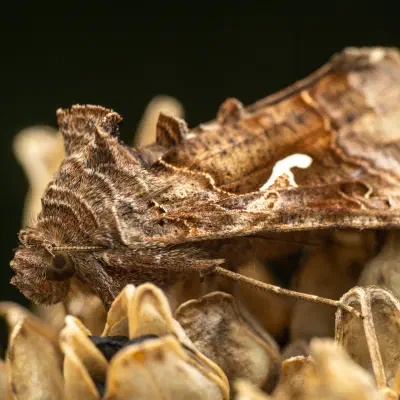
Euplagia quadripunctaria is widely distributed in Europe from Estonia and Latvia in the north, to southern Great Britain and France in the west, and the Mediterranean coast and islands in the south. It is also found in western Russia, the southern Urals, Asia Minor, Rhodes and nearby islands, the Near East, Caucasus, southern Turkmenistan, and Iran. Individuals are known to migrate northwards from their regular breeding grounds during the summer.
Jersey Tiger (lat. Euplagia quadripunctaria)


Distribution

Subspecies
Euplagia quadripunctaria quadripunctaria (Europe, Caucasus, Transcaucasus, northern Anatolia, northern Iran, southern Turkmenistan) Euplagia quadripunctaria fulgida (South Turkey, Syria, Lebanon) Euplagia quadripunctaria rhodosensis (Western Turkey and neighbouring islands of Greece)

Polymorphism
The hindwings are bright red across most of the range of the species, but in the northwest of the range the species is polymorphic, with red, orange, or yellow hindwings. The colour is part of the species' warning coloration (aposematism), signalling to possible predators that the species is distasteful, in its case protected by harmful chemicals. It is unusual for such warning signals to vary, as a single pattern is most likely to be an
effective deterrent. The polymorphism is created by two genes. Each gene has two alternative forms (alleles), one dominant to the other. One of the genes is epistatic to the other. One gene gives red if the dominant allele R is present, else orange (if homozygous for the recessive allele r); the other gene gives yellow if homozygous for its recessive allele (yy), regardless of the alleles of the red gene. Thus the Y allele is
required for red or orange to appear. The Y allele may enable metabolism of the yellow pigment to orange, which the R allele can then process further to give red, which would explain the epistasis.

Conservation
The Jersey tiger is the only lepidopteran which has been designated as a 'priority species' under Annex II of the Habitats Directive in the European Union, as of 1992. This means that areas in which it occurs can be declared Special Areas of Conservation.

Further reading
Roesler, U. (1968). "Panaxia quadripunctaria ssp. ingridae ssp. nov. (Lepidoptera, Arctiidae)". Entomologische Zeitschrift. 78 (24): 280–284, Stuttgart.

External links
Kimber, Ian. "72.030 BF2067 Jersey Tiger Euplagia quadripunctaria (Poda, 1761)". UKMoths. Retrieved 23 August 2019. Butterfly Conservation: Saving butterflies, moths and our environment Fauna Europaea Lepiforum e.V. De Vlinderstichting (in Dutch) Videos about the Jersey tiger: [1] and [2]
This is not intended to be a dry lexicon. Personal stories and sensitive articles form the framework for our pictures: „The jumper and the algorithm“
A spider becomes a content star
Full post

Copyright
This article uses material from the Wikipedia article Euplagia quadripunctaria the free encyclopedia Wikipedia which is released under Creative Commons Attribution-ShareAlike 4.0 International License). On Wikipedia a list of authors is available.