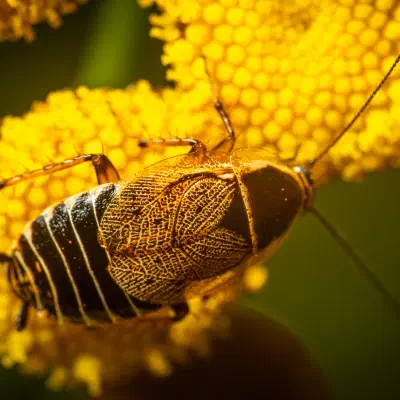
The range of the Meadow Grasshopper extends from the Atlantic coast of Europe, including the British Isles, to the Urals. It is found from Scandinavia in the north to southern Spain and Anatolia in the south. It prefers moist vegetation and in southern regions is typically found in river valleys and at high altitudes (up to approximately 2000 m), but not in arid areas.
Meadow Grasshopper (lat. Pseudochorthippus parallelus)


Distribution

Physical appearance
Females grow to approximately 2 centimetres (3⁄4 in) and are larger and less active than males, which grow to approximately 1.5 centimetres (5⁄8 in). Both sexes are flightless. In females the wing cases (covering vestigial wings) extend only a short way down the abdomen, whereas in males, the wing cases extend almost to the tip of the abdomen. Their colour can vary with green, brownish, purple-red and pink forms having been recorded, although green
forms are most common. Colour forms are genetically determined and some populations can show high frequency of pink grasshoppers. Pseudochorthippus parallelus is distinguished from similar species by the approximately parallel nature of the bars (pronotal side-keels) on the back of the neck which gives the species its name.

Possible utilization for human food
Due to the high density of these insects in Western Europe, some researchers have proposed using them as a source of human food. These insects contain 69% protein by dry weight, with an excellent amino acid profile and digestibility. However, Aman Paul and his co-workers have indicated that, before these insects can be introduced as a food source for humans, a thorough examination must be conduced to identify any potential toxic or allergic conditions that
could result from their consumption.

Subspecies
Various races of the meadow grasshopper have been described in different regions with forms described as separate subspecies. They include: P. parallelus erythropus (Faber, 1958) - Iberian Peninsula P. parallelus parallelus (Zetterstedt, 1821) - nominate subsp., widespread including the British Isles P. parallelus serbicus Karaman, Z., 1958 P. parallelus tenuis (Brullé, 1832) - Greece These subspecies are the result of the allopatric separation of P. parallelus populations into separate southern European refugia during the Pleistocene ice ages. The most widespread
subspecies, P.p. parallelus, is found throughout much of Europe but is replaced by P.p. erythropus in Iberia. The Iberian erythropus subspecies is characterized in the field by red hind tibiae and differences in the mating song although other studies demonstrate additional differences in morphological, behavioural, chromosomal and DNA sequence characters. There is a hybrid zone between P.p. erythropus and P.p. parallelus running along the ridge of the Pyrenees mountains between Spain and France. A similar
hybrid zone has been described between forms in France and Italy that runs along the Alps.

Speciation
The subspecies do not appear to be speciating through reinforcement. This is one of the most significant pieces of evidences against speciation by reinforcement.

This is not intended to be a dry lexicon. Personal stories and sensitive articles form the framework for our pictures: „Franz and his journey into the world of humans“
Franz, the friendly seed beetle, wakes up as a human one morning and uses his new abilities to improve the world of arthropods.
Full post

Copyright
This article uses material from the Wikipedia article Pseudochorthippus parallelus the free encyclopedia Wikipedia which is released under Creative Commons Attribution-ShareAlike 4.0 International License). On Wikipedia a list of authors is available.