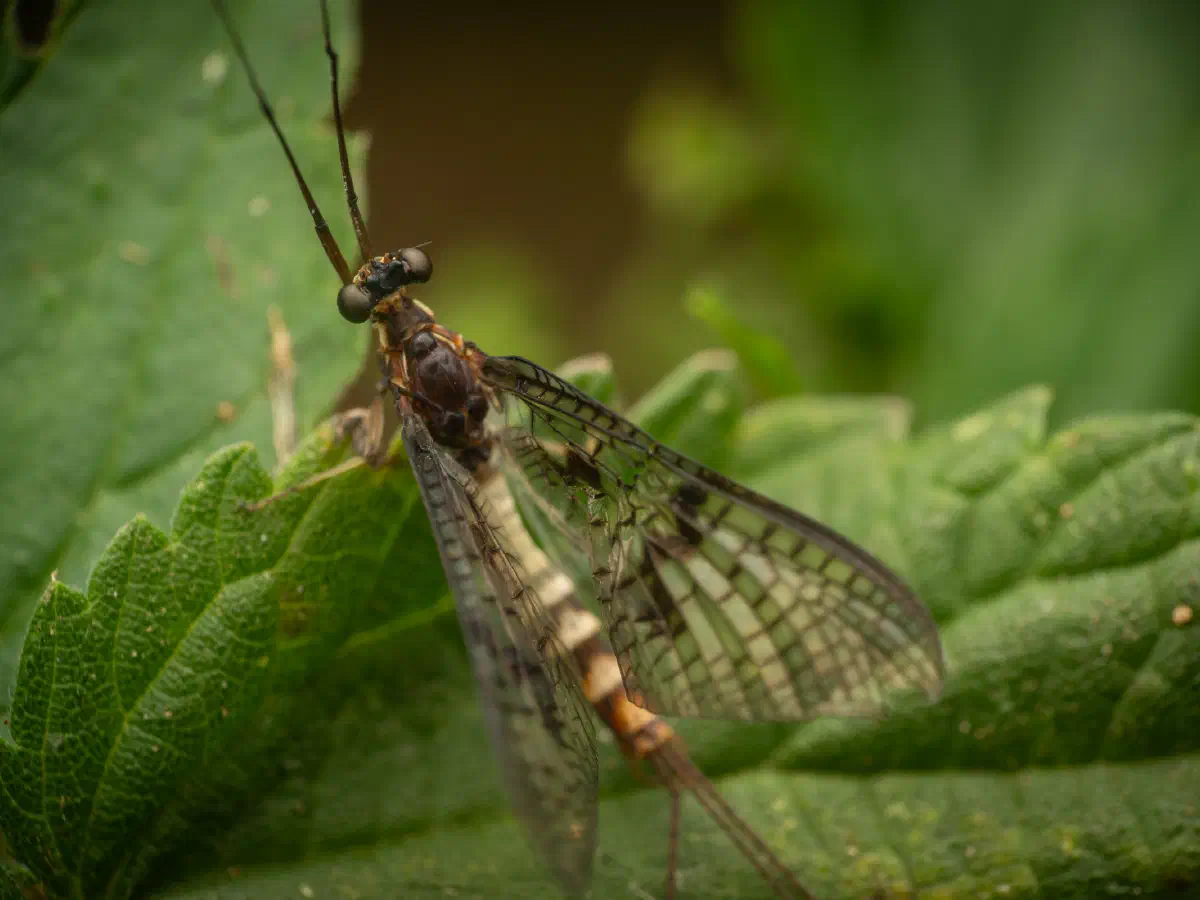
European Green Drake (lat. Ephemera danica)

European Green Drake

Description

Ephemera danica can reach an imago size of 15–20 mm (0.6–0.8 in) in males, while females are larger, reaching 16–25 mm (0.6–1.0 in). This mayfly, with its characteristic markings and three tails (cerci), is the most commonly seen of British Ephemeridae. Imago wings are translucent with dark veining, while in subimago they are dull and yellowish with brown veins. Moreover, forelegs and the tails of the spinners are much longer than in duns. Mouthparts are

non-functional, as adults do not feed. These insects are aeroplankton and usually are food for swallows, trout and various species of amphibians and spiders.
Copyright and source information
European Green Drake

Life cycle

The life cycle usually lasts one or two years, but sometimes the developing nymphal forms may last for up to three years. Nymphs can reach a length of about 30 millimetres (1.2 in). They dig tunnels into the gravel in the beds of rivers and feed by filtering organic detritus, before emerging in spring and moving towards shallow waters. The adults mainly can be found in May–June (hence the common name of mayfly), at the end

of many larval stages. Adults may be often present between April and November. The lifetime of adults is very short (around four days at the most), hence its genus name (Ephemera). Females fly on the surface of the water and dip their abdomen onto the surface to lay eggs. At the end of this process, females fall onto the surface of the water and die.

Copyright and source information
European Green Drake

Distribution and habitat

This species is commonly found in clear water rivers and lakes with sandy or gravel bottoms throughout Europe, including the British Isles.

Copyright and source information
European Green Drake

See also

List of mayflies of the British Isles

Copyright and source information
European Green Drake

References

Mutsunori Tokeshi (1985). "Life-cycle and production of the burrowing mayfly, Ephemera danica: a new method for estimating degree-days required for growth". Journal of Animal Ecology. 54 (3): 919–930. doi:10.2307/4387. JSTOR 4387. Catalogue of Life Media related to Ephemera danica at Wikimedia Commons Data related to Ephemera danica at Wikispecies

Copyright and source information

This is not intended to be a dry lexicon. Personal stories and sensitive articles form the framework for our pictures: „Accidental queen“ On the understanding of roles in nature

Full post

Accidental queen