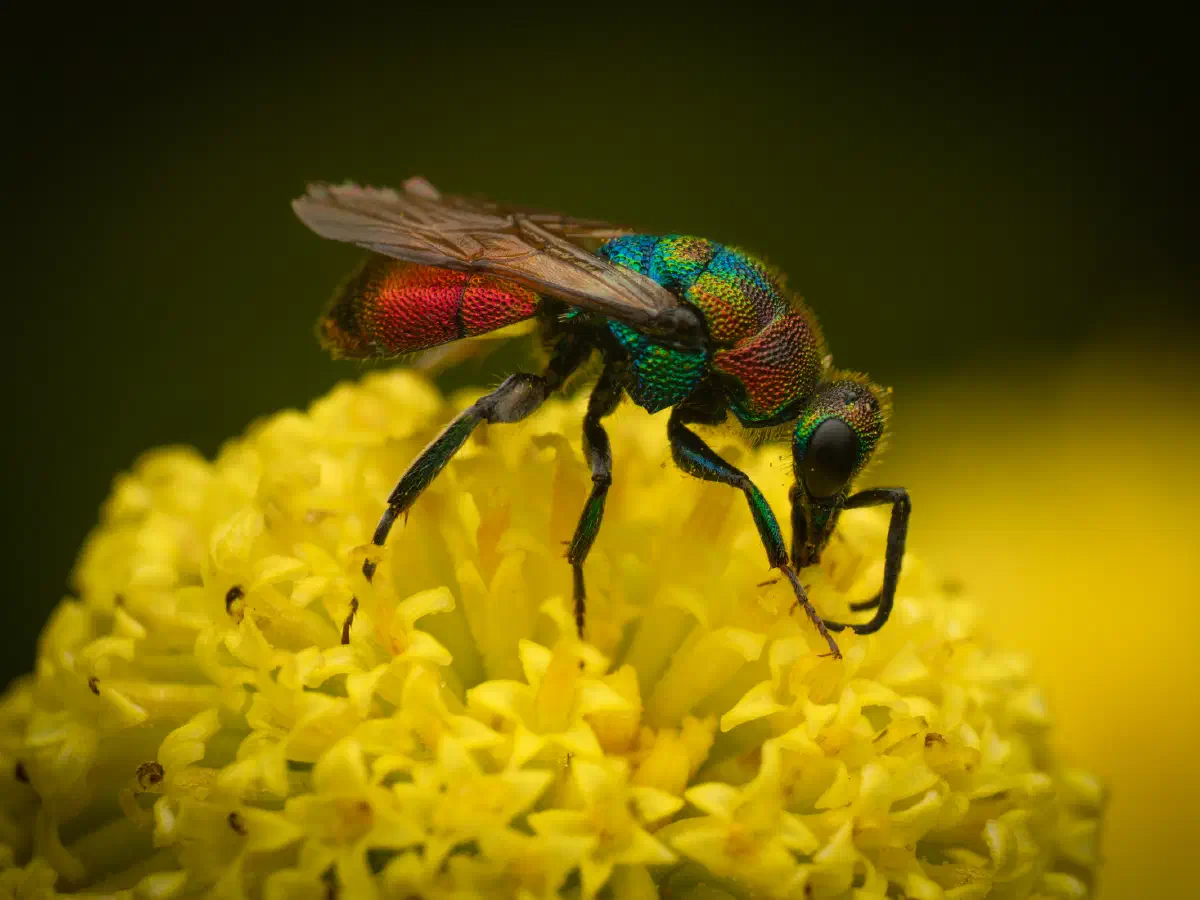
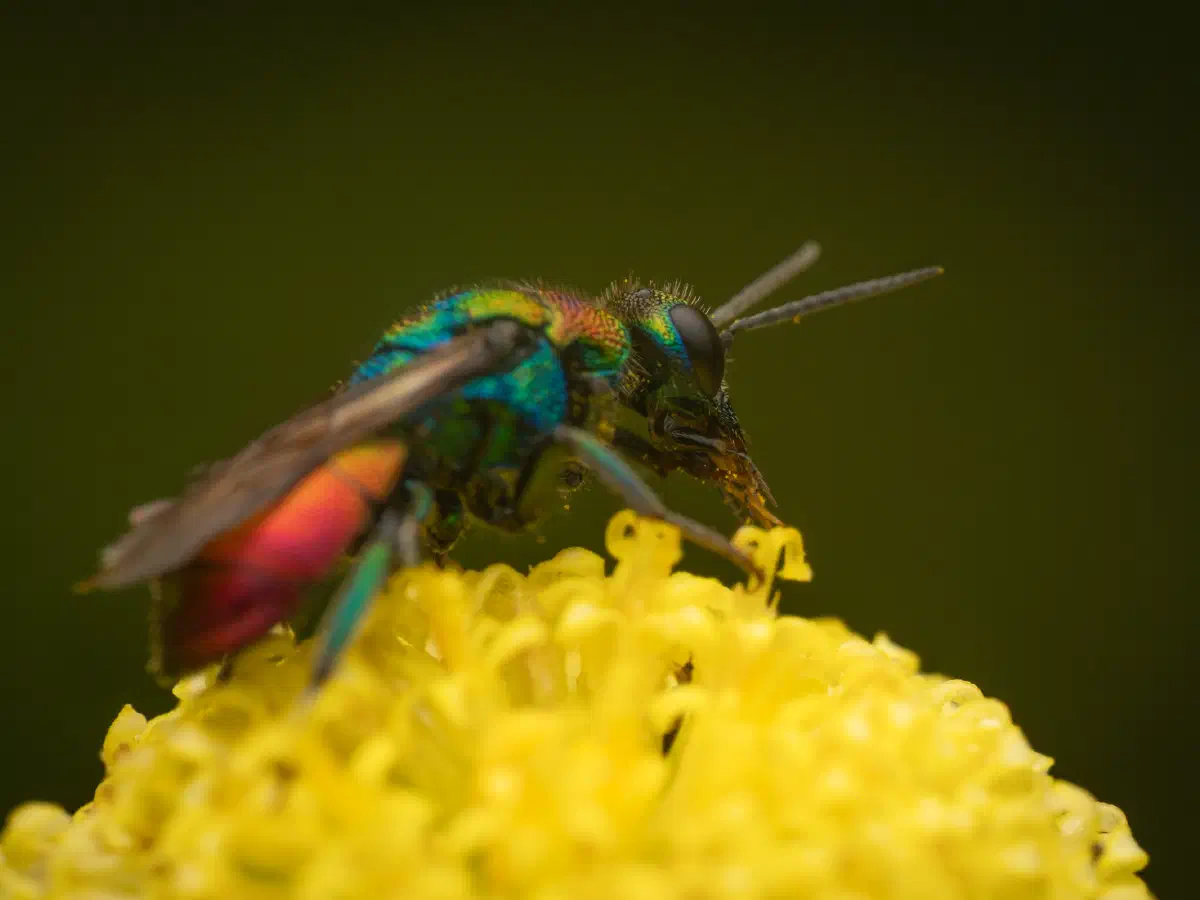
Hedychrum rutilans (lat. Hedychrum rutilans)

Hedychrum rutilans
Hedychrum rutilans

Biology

Hedychrum rutilans is a cleptoparasite and parasitoid of larvae of beewolves (Philanthus triangulum and Philanthus coronatus). The female cuckoo wasp lays its eggs on the paralyzed honeybee workers serving as provisions for the beewolf larvae, placed by the female beewolf in its brood cells. The cuckoo wasp larvae feed on the honeybees and on the larvae of the beewolf. Adults grow up to 4–10 mm (0.16–0.39 in) long and can be encountered from late

June to September, often feeding on flowers of Mentha species, Achillea millefolium and Euphorbia paralias, but also on honeydew or various exudates. They prefer sandy and warm habitats.
Copyright and source information
Hedychrum rutilans

Subspecies

Hedychrum rutilans var. rutilans Dahlbom, 1854 Hedychrum rutilans var. subparvulum Linsenmaier, 196 Hedychrum rutilans var. viridiauratum Mocsáry, 1889 Hedychrum rutilans var. viridiaureum Tournier, 1877

Copyright and source information
Hedychrum rutilans

External links

Strohm, Erhard; Kroiss, Johannes; Herzner, Gudrun; Laurien-Kehnen, Claudia; Boland, Wilhelm; Schreier, Peter; Schmitt, Thomas (2008). "A cuckoo in wolves' clothing? Chemical mimicry in a specialized cuckoo wasp of the European beewolf (Hymenoptera, Chrysididae and Crabronidae)". Frontiers in Zoology. 5: 2. doi:10.1186/1742-9994-5-2. PMC 2262889. PMID 18190702.

Copyright and source information

This is not intended to be a dry lexicon. Personal stories and sensitive articles form the framework for our pictures: „Franz and his journey into the world of humans“ Franz, the friendly seed beetle, wakes up as a human one morning and uses his new abilities to improve the world of arthropods.

Full post

Franz and his journey into the world of humans