Tree Bumble Bee (lat. Bombus hypnorum)

Tree Bumble Bee
Tree Bumble Bee

Description

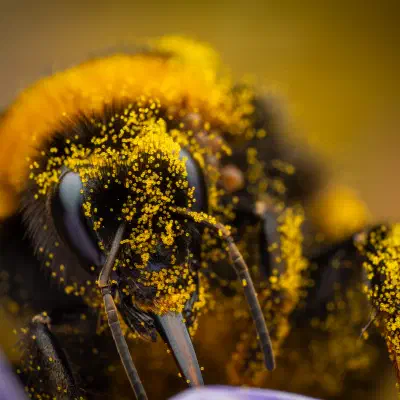
Bombus hypnorum has a short proboscis and a rounded head. The thorax is usually of a uniformly ginger color (but examples with a darker, or even black thorax occur), the abdomen is covered in black hair, and the tail is always white. In workers, the first tergite (abdominal segment) is black-haired, but a proportion of males may have ginger hairs intermixed with the black hair, both on the face and on the first abdominal tergum.

On the European continent, individuals with extended yellow coloration exist. Workers are often (but not always) small, while drones are much bigger in comparison. The queens vary in size.

Copyright and source information
Tree Bumble Bee

Taxonomy and phylogeny

Bombus hypnorum is part of the genus Bombus. Its closest genetic relatives are B. jonellus and B. sichelli.

Copyright and source information
Tree Bumble Bee

Distribution

B. hypnorum is a common bumblebee species in continental Europe and northern Asia, from northern France to Kamchatka in the east, and from the Pyrenees to the mountains in northern Europe. In the Balkans it is found in northwestern Greece. It is not found, though, in the Mediterranean, or the steppes of eastern Europe, only in the mountains of the Iberian Peninsula and not south of Tuscany in Italy. The bumblebee was first observed in

United Kingdom on 17 July 2001 close to the village of Landford in Wiltshire and has since been spreading widely. In August 2008, B. hypnorum was found in Iceland, and new queens have been found each year since. It is likely that it will continue to stay in Iceland and prosper in close living with humans near dense settlements, such as Reykjavík, but will most probably not venture into the more rural and colder parts

of Iceland. In the U.K., it has now spread from England up to the north of Scotland and Wales. It reached Ireland in 2017.

Copyright and source information
Tree Bumble Bee

Habitat

This bumblebee often lives near human settlements. It prefers to build its nest above ground and often inhabits bird boxes. B. hypnorum likes to live in forests, but in places where there are not as many trees, it favours human dwellings. It likes to live in holes and walls in the trees unlike other members of the Bombus genus. B. hypnorum does not stay in areas where there is a high amount of rapeseed cover.

Copyright and source information
Tree Bumble Bee

Colony cycle

The tree bumblebee has a short breeding cycle. Nests are begun by single queens in March. These queens produce a brood of workers, then queens and males. The first cycle is completed from mid-May to early July (depending on the season). A smaller second generation is produced in late summer in favorable years. Larger colonies have heavier queens.

Copyright and source information
Tree Bumble Bee

Breeding

Queens in this species can be polyandrous. Multiple mating is not common in bumblebees. In this species it is related to short matings, possibly with little sperm transferred. Because of multiple mating, sisters in a colony may have different fathers.

Copyright and source information
Tree Bumble Bee

Interactions

They maintain a symbiotic relationship with phoretic mites, which they transport, and which probably feed on mushrooms or nest parasites.

Copyright and source information
Tree Bumble Bee

External links

Bombus hypnorum distribution map at DiscoverLife.org Bees, Wasps and Ants Recording Society: page on Bombus hypnorum Hymettus information sheet on tree bee [1] Video about Bombus Hypnorum

Copyright and source information

This is not intended to be a dry lexicon. Personal stories and sensitive articles form the framework for our pictures: „The Spanish crane fly“ Is Bavaria the new Barcelona? Mio, the mosquito, experiences climate zones gone astray.

Full post

The Spanish crane fly