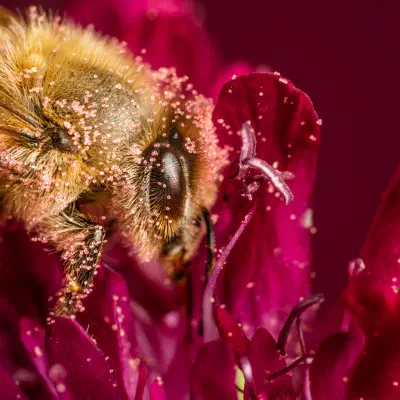
Humans have been collecting honey from western honey bees for thousands of years, with evidence in the form of rock art found in France and Spain, dating to around 7,000 BCE. The western honey bee is one of the few invertebrate animals to have been domesticated. Bees were likely first domesticated in ancient Egypt, where tomb paintings depict beekeeping, before 2600 BC. Europeans brought bees to North America in 1622.
Beekeepers have selected western honey bees
for several desirable features:
the ability of a colony to survive periods with little food
the ability of a colony to survive cold weather
resistance to disease
increased honey production
reduced aggressiveness
reduced tendency to swarm
reduced nest building
easy pacification with smoke
These modifications, along with artificial change of location, have improved western honey bees from the point of view of the beekeeper, and simultaneously made them more dependent on beekeepers for their survival. In Europe, cold weather survival was likely selected for,
consciously or not, while in Africa, selection probably favoured the ability to survive heat, drought, and heavy rain.
Authors do not agree on whether this degree of artificial selection constitutes genuine domestication. In 1603, John Guillim wrote "The Bee I may well reckon a domestic insect, being so pliable to the benefit of the keeper." More recently, many biologists working on pollination take the domesticated status of western honey bees for granted. For example, Rachael Winfree
and colleagues write "We used crop pollination as a model system, and investigated whether the loss of a domesticated pollinator (the honey bee) could be compensated for by native, wild bee species." Similarly, Brian Dennis and William Kemp write: "Although the domestication of the honey bee is closely connected to the evolution of food-based socio-economic systems in many cultures throughout the world, in current economic terms, and in the U.S. alone, the estimated wholesale value
of honey, more than $317 million dollars in 2013, pales in comparison to aggregate estimated annual value of pollination services, variously valued at $11–15 billion."
On the other hand, P. R. Oxley and B. P. Oldroyd (2010) consider the domestication of western honey bees, at best, partial. Oldroyd observes that the lack of full domestication is somewhat surprising, given that people have kept bees for at least 7,000 years. Instead, beekeepers have found ways to manage
bees using hives, while the bees remain "largely unchanged from their wild cousins".
Leslie Bailey and B. V. Ball, in their book Honey Bee Pathology, call western honey bees "feral insects", in contrast to the domestic silk moth (Bombyx mori) which they call "the only insect that has been domesticated", and refer to the "popular belief among many biologists as well as beekeepers that bees are domesticated". They argue that western honey bees are able to
survive without human help, and in fact require to "be left at liberty" to survive. Further, they argue that even if bees could be raised away from the wild, they would still have to fly freely to gather nectar and pollinate plants. Therefore, they argue, beekeeping is "the exploitation of colonies of a wild insect", with little more than the provision of a weatherproof cavity for them to nest in. Likewise, Pilar de la Rua
and colleagues argue that western honey bees are not fully domesticated, because "endemic subspecies-specific genetic footprints can still be identified in Europe and Africa", making conservation of wild bee diversity important. Further, they argue that the difficulty of controlling drones for mating is a serious handicap and a sign that domestication is not complete, in particular as "extensive gene flow usually occurs between wild/feral and managed honeybee populations".