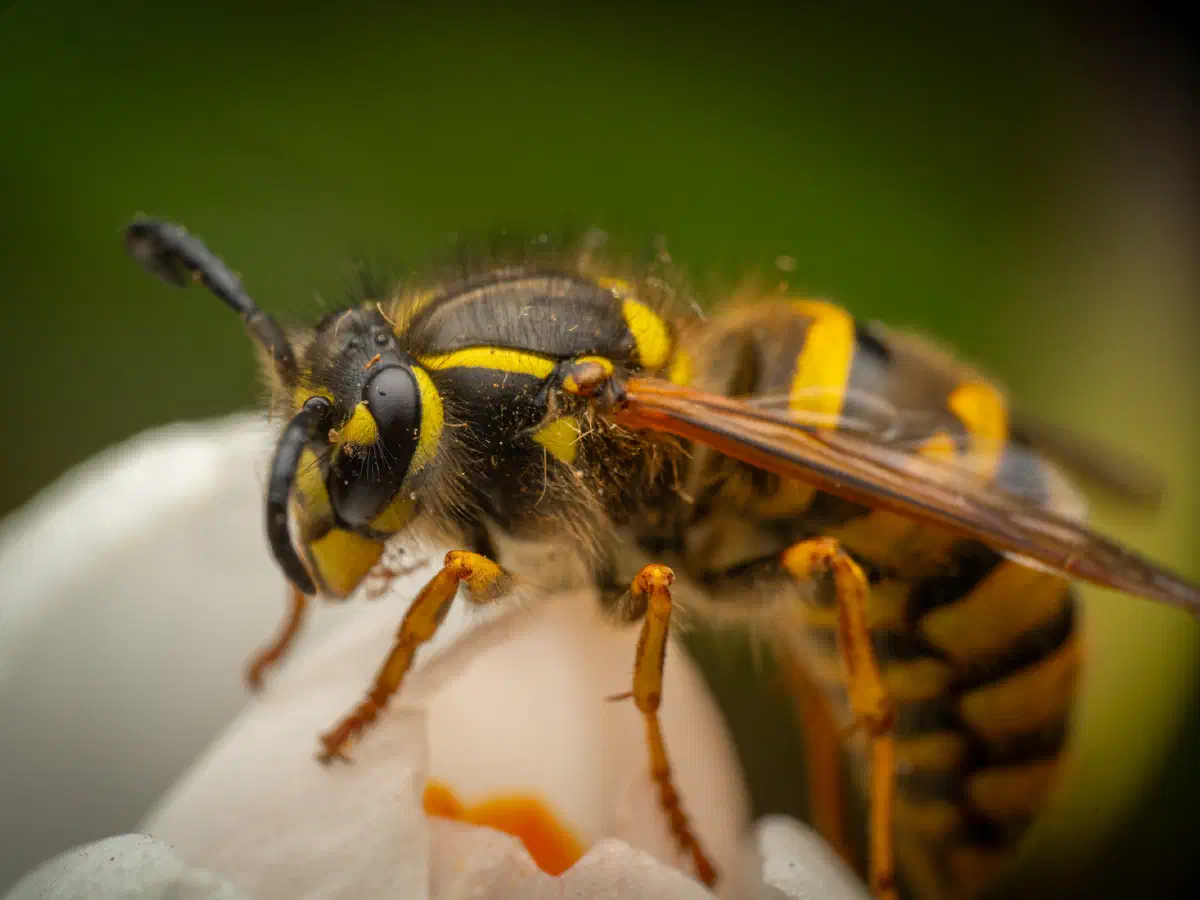
After coming out of hibernation in the spring, the queen forages for flowers or shrubs and begins looking for nesting sites. She flies low on the ground, searching for any round, dark object or depression. If it is a hole, she flies in to inspect the details if it is suitable and if not moves on to the next hole. What constitutes a "perfect" nest is yet to be discovered, but it is mainly speculated
that the queen's physiological state is the main deciding factor of the time and the place of nesting. When she has found a suitable site for nesting, she performs dance-like wing movements which allow her to locate the site even after she has left the area.
After she has fixed the position of the nest, she begins to build it. She repeats the procedure of bringing in a pulp, attaching it to the nest to form
a spindle and flying back out to bring in more pulp. During this process, the queen clings to the nest with her two posterior pairs of legs and attaches the pulp using her anterior legs and mouth parts. She builds 20–30 cells before initial egg-laying, fashioning a petiole and producing a single cell at the end of it. Six further cells are then added around this to produce the characteristic hexagonal shape of the nest
cells. One egg is laid in each cell, and as it hatches, each larva holds itself in the vertical cell by pressing its body against the sides.
When the nest is completed, the queen is replaced by the workers as the foraging force and instead is now concerned only with nursing and egg producing. Her ovaries develop, her abdomen becomes distended with eggs, and she loses the ability to fly.
After the founding phase has been completed,
the colony encounters a change where the workers begin to build queen cells. Once the workers start building on the queen cells, no more worker cells are built, but those that still have brood growing in them are retained. The majority of the food resource brought in by the workers is fed to the queen larvae, known as gynes and the lack of feeding for other larvae causes the prolongation of their larval periods. To
ensure that only the queen's eggs are reared to adulthood, female workers remove worker-laid eggs in a process known as worker policing.
When the queen has completed her job of producing daughter queen larvae, she dies, leaving a crop of virgin queens which will leave the nest, mate, hibernate, and reproduce in the following spring. After the queen's death, the coordination of the colony breaks down and the workers begin to lay eggs. The rate and
amount of foraging decrease drastically after the queen's death, so it is unable to support all the workers and their brood. This is when cannibalism occurs among the workers and furthermore, the workers tear off their cells and carry them out of the nest, dropping the temperature of the entire nest. Once this stage is reached, the remaining workers die of cold or starvation.