Morphology and appearance
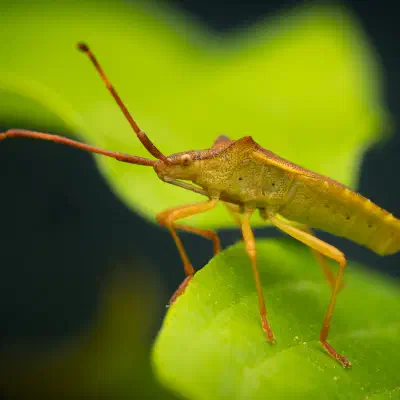
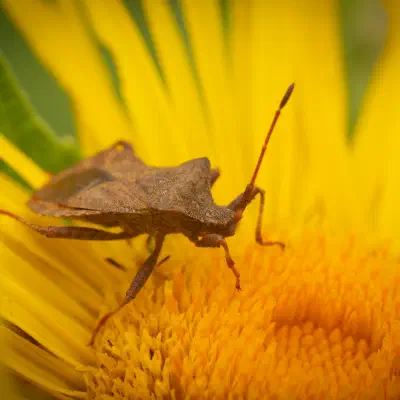
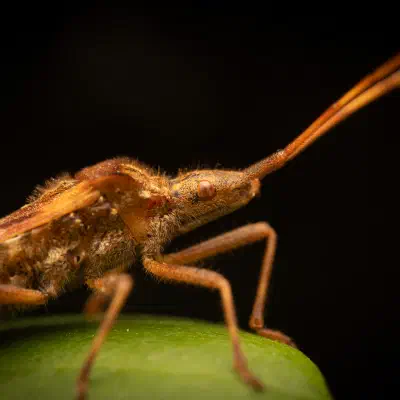
The Coreidae commonly are oval-shaped, with antennae composed of four segments, numerous veins in the membrane of the fore wings, and externally visible repugnatorial stink glands. They vary in size from 7 to 45 mm long, which implies that the family includes some of the biggest species of Heteroptera. The body shape is quite variable; some species are broadly oval, others are elongated with parallel sides, and a few are slender. Many species with the “leaf-footed” tibiae are very slender with conspicuous expansions of the hind tibiae, but some robust species also have decided expansions. Some species are covered with spines and tubercles. As an example of these, the tribe Phyllomorphini Mulsant & Rey, 1870, are strikingly aberrant, with thin legs, spiny bristles, and laciniate outlines and adornments.
Many of the more robust species have grossly enlarged, thickened, and bowed hind femora armed with spikes on the inner edge, and with hind tibiae to match, though the enlargement of the tibiae is less exaggerated.
In the nymphs, the openings of the two repugnatorial stink glands of the Coreidae are visible as two projections or spots on the medial line of the dorsal surface of the abdomen, one at the anterior and one at the posterior edge of the fifth abdominal tergite above the glands inside. During the final ecdysis, the anatomy is rearranged and the glands end up in the metathorax, opening laterally through ostioles between the mesothoracic and metathoracic pleura.