Biology
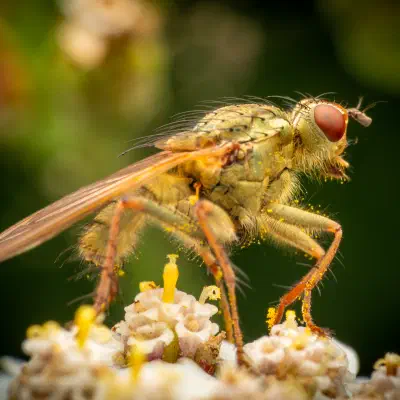
The larval biology of this family is actually quite diverse, including plant feeders (leaf miners, stem borers, or feeding in seed capsules), aquatic predators, and predators on other insect larvae in wet situations - such as piles of rotting vegetable matter, seaweed, or dung. The adults are predators on other small insects, and while they are commonly seen on flowers, they are hunting prey there, rather than acting as pollinators. They are, in fact, one of the better predators of blow-flies; thus, they are beneficial agents of biological control. Some species are attracted to dung in great numbers. One of the best-known species of this family is the yellow dung fly (Scathophaga stercoraria) (Linnaeus, 1758). The golden-yellow, densely pilose males of this species gather on cattle dung and may, in parts of its range, be observed at all times of the year.
Worldwide, about 500 described species are placed in 66 genera. The great majority are found in the Palearctic and Nearctic regions and the family is almost confined to the Northern Hemisphere, with only five species so far known from the Southern Hemisphere (and two of these are common northern species of Scathophaga, which have probably been imported with livestock into South Africa and Brazil). The most diverse fauna is found in the Russian Far East, and many new species have been described from this area over the last few decades. Because of the northerly distribution of many species, even within the Holarctic, Vockeroth (1987) has described this as the most northerly distributed of all fly families. He reports that, of the 150 species recorded from Canada, 25 are confined to the Arctic tundra.
Fifty-four species are currently recorded from the British Isles alone and nearly all of these have a Holarctic distribution.