Social behavior
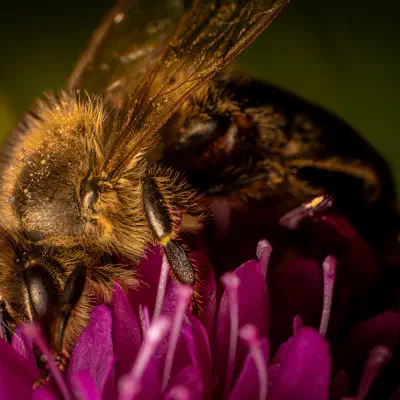
Social insects, such as termites, ants and many bees and wasps, are eusocial. They live together in such large well-organized colonies of genetically similar individuals that they are sometimes considered superorganisms. In particular, reproduction is largely limited to a queen caste; other females are workers, prevented from reproducing by worker policing. Honey bees have evolved a system of abstract symbolic communication where a behavior is used to represent and convey specific information about the environment. In this communication system, called dance language, the angle at which a bee dances represents a direction relative to the sun, and the length of the dance represents the distance to be flown. Bumblebees too have some social communication behaviors. Bombus terrestris, for example, more rapidly learns about visiting unfamiliar, yet rewarding flowers, when they can see a conspecific foraging on the same species.
Only insects that live in nests or colonies possess fine-scale spatial orientation. Some can navigate unerringly to a single hole a few millimeters in diameter among thousands of similar holes, after a trip of several kilometers. In philopatry, insects that hibernate are able to recall a specific location up to a year after last viewing the area of interest. A few insects seasonally migrate large distances between different geographic regions, as in the continent-wide monarch butterfly migration.