


Description
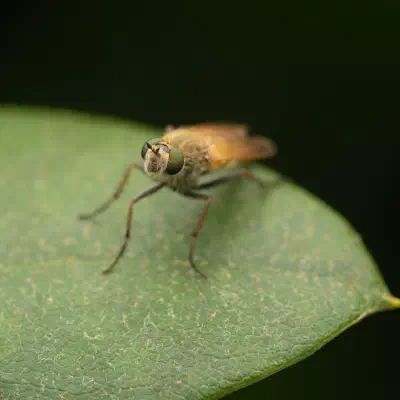
Adult Therevidae are small- to medium-sized with a body length of 2.4 to 18 mm and a hairy integument. The coloration ranges from shades of yellow to black, but commonly the background colour is masked by the tomentum. The compound eyes are generally larger in males, which in many species are actually holoptic. Females have well-developed compound eyes, but are clearly dichoptic. There are three ocelli. The antennae are relatively short. The scape is elongated, the pedicel very short, and the first flagellomere is conical and elongated, the apex bearing a compound stylus with one to three segments. The scape and pedicel are pubescent; In contrast to the related and confusingly similar family Asilidae, the labium in the Therevidae is not a piercing, predatory organ, but ends in two fleshy labella adapted to the sucking of liquid foods. Another difference is that, though Therevidae commonly have fluffy setae above the mouthparts, the setae are not stiff bristles like the protective chaetae comprising the mystax of most species of Asilidae. Furthermore, in the Asilidae the depression on the vertex between the eyes, tends to be more obvious than in the Therevidae. The thorax is broad and moderately convex, with long bristles (macrotrichae). The legs are long and slender, with femora and tibiae bearing bristles; the tibiae are without apical spurs and the tarsi are provided with empodia or without the median pretarsal. The wings are well developed, hyaline or opaque, often with pigmentation of the veins located at the termination of the transverse and longitudinal veins. The abdomen is tapered and elongated, typically 3 to 4 times as long as its broadest width when not extended for activities such as oviposition. Eight abdominal segments (uriti) are externally visible.
The wing venation is relatively complex but without a particular conformation to distinguish the Therevidae from other families of Asiloidea. The radius is divided into four branches, with R 2 +3 undivided. The branch R 4 is long and winding and reaches the costal margin, the branch R 5 terminates on the posterior border, so the second submarginal cell is open at the apex of the wing. The media is divided into four branches, all independent but with M 3 and M 4 convergent. The transverse medial vein closes the discal cell. This has an elongated shape and terminates at the apex with three angles from which the first three branches of media spring. The fourth branch, M 4 (or CuA 1 according to a different interpretation), originates from the apex of the posterior basal discal cell. The cubit and anal converge on a short common branch before reaching the apex. The larva is apodous and eucephalic, cylindrical, very long and thin, and with tapered ends. The integument is smooth, white, or pink. The head capsule is well developed, but narrower than the other regions.


