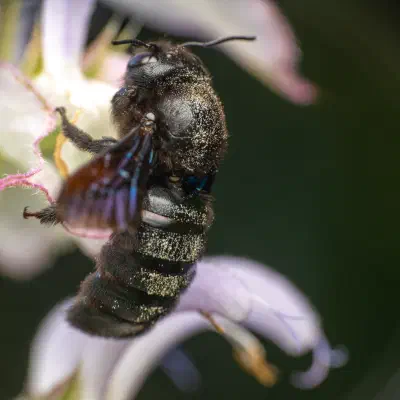
Violet Carpenter Bee (lat. Xylocopa violacea)

Violet Carpenter Bee
Scroll to read on

Xylocopa violacea, the violet carpenter bee, is the common European species of carpenter bee, and one of the largest bees in Europe. It is also native to Asia.

Distribution

The range of Xylocopa violacea extends from Europe eastward across Asia as far as central China, restricted to latitudes above 30 degrees. In India, any all-black species of Xylocopa are referred to by the common name “bhanvra” (or “bhomora” – ভোমোৰা – in Assamese), and reports and sightings of bhanvra are commonly misattributed to this species; however, this species is found only in the northern regions of Jammu and Kashmir and Punjab. Most sightings refer to any of several other common black Xylocopa, such as X. nasalis, X. tenuiscapa, or X. tranquebarorum. In 2006, Xylocopa violacea was reported from Cardigan, Wales. In 2007, it was found breeding for the first time in England, in Leicestershire. This follows a northwards expansion of its range in France, Germany, and the Channel Islands. In 2010 it was recorded in Northamptonshire and Worcestershire.

Description

Violet carpenter bees hibernate over winter and they emerge in the spring, usually around April or May. Hibernation is undertaken by the adults in wood where there are abandoned nest tunnels. In the late spring or early summer, they may be seen around searching for mates and suitable nesting sites. After mating, the gravid females bore tunnels in dead wood, which is where the name “carpenter bee” comes from, although old nest tunnels may be used. Like other solitary bees, the female creates the nest alone. The eggs are laid within a series of small cells, each of which is supplied with a pollen ball for the larvae to feed upon. The adults emerge in late summer then hibernate until the following year.

Ancestry graph

Arthropods Insects Narrow-waisted Wasps, Ants, and Bees Honey Bees, Bumble Bees, and Allies Bumble Bees Violet Carpenter Bee Western Honey Bee

Copyright and source information

This project wouldn’t exist without Wikipedia and iNaturalist! As citizen scientists, we benefit enormously from the community’s shared knowledge. This article uses material from Wikipedia and iNaturalist. The images on this website are licensed under Attribution-NonCommercial-ShareAlike 4.0 International.

This article uses material from the Wikipedia article Xylocopa violacea the free encyclopedia Wikipedia which is released under Creative Commons Attribution-ShareAlike 4.0 International License). On Wikipedia a list of authors is available.

This is not intended to be a dry lexicon. Personal stories and sensitive articles form the framework for our pictures: „Accidental queen“ On the understanding of roles in nature

Full post

Accidental queen