Description
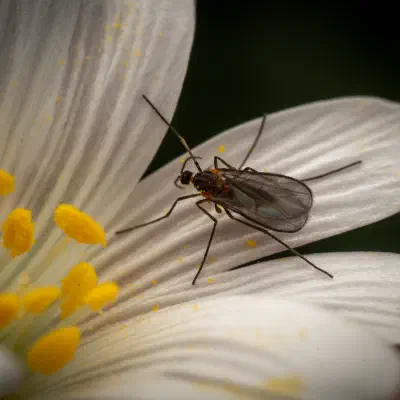
Cecidomyiidae are minute to small (0.5–3.0 mm), rarely larger (up to 8 mm, wing length 15 mm) flies with a delicate appearance. Except for a few genera with reduced wings, the eyes are holoptic. The mouthparts are reduced. Cecidomyiid antennae are notably long, with 12–14 segments, (sometimes fewer and up to 40 in some genera). The antennal segments either consist of a basal thickening and petiole or they are binodal, with a proximal node, an intermediate petiole and a distal node. Basal, medial, and apical whorls of hairs occur on the antennal segments. In some species, whorls of loop-shaped sensory filaments are also found, the basal or medial one sometimes being reduced. Some gall flies have only one (basal) whorl of hairs on the antennal segments, and the sensoria (transparent sensory appendages) differ in size and shape. The filaments are thread-like in the Porricondylinae and in all the Cecidomyiinae and take the form of long loops in the supertribe Cecidomyiidi). Ocelli are present only in the Lestremiinae. The wings are usually clear, rarely patterned. The wing bears microtrichia, often as scales, and some species have macrotrichia. The number of longitudinal veins is reduced. Only veins R1, R4+5, M3+4 and Cu1 are well developed in most species. The medial veins M1 and M2 are developed only in primitive groups, and the costa usually has a break just beyond vein R5. The legs are long and slender, without apical bristles. Gall midge larvae, and many adults, are orange or yellow in color due to carotenoids. Cecidomyiidae are among the very few animals which can synthesize carotenoids, but its unknown to what degree de novo biosynthesis of carotenoids accounts for their characteristic color as opposed to dietary sequestration or endosymbionts. The genes responsible for carotenoid synthesis likely originate from horizontal gene transfer from a fungal donor.
The genitalia of males consist of gonocoxites, gonostyles, aedeagus, and tergites 9 and 10. Lower (in the evolutionary sense) gall flies often have sclerotized parameres and a more or less transparent plate (the tegmen) located above theaedeagus-the tegmen. In higher gall flies, the parameres and tegmen are not developed. In these, instead, close to the aedeagus, is a triangular basal outgrowth of the gonocoxites called the gonosterna. Supporting structures called apodema are located near the base of the genitalia in males; these are often equipped with two outgrowths. The ovipositor is short, lamelliform, or long, mobile, and in some species, acicular. The larva is peripneustic. The head is tiny, cone-shaped, and has two posterolateral extensions. The mouthparts are reduced, with minute styliform mandibles. The relatively prominent antennae are two-segmented. Integumental setae or papillae are important in taxonomy since they are constant in number within groups. The prothorax has sclerotized sternal spatula (most). The anus is terminal in the Lestremiinae and paedogenetic in the Porricondylinae and ventral in other groups. The pupa is exarate (in a few species it is enclosed within the last instar larval integument). The anterior spiracle and anterior angle of antennal bases is prominent (most).