Relationship with humans
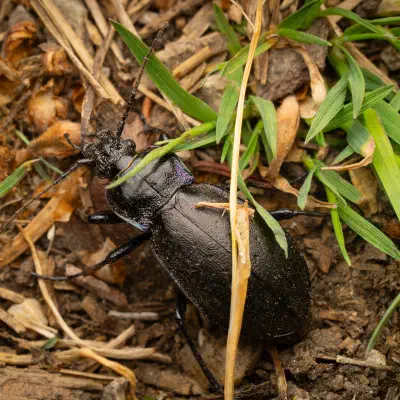
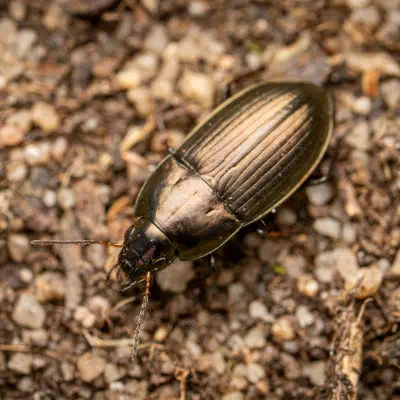
As predators of invertebrates, including many pests, most ground beetles are considered beneficial organisms. The caterpillar hunters (Calosoma) are famous for their habit of devouring prey in quantity, eagerly feeding on tussock moth (Lymantriinae) caterpillars, processionary caterpillars (Thaumetopoeinae) and woolly worms (Arctiinae), which, due to their urticating hairs, are avoided by most insectivores. Large numbers of the forest caterpillar hunter (C. sycophanta), native to Europe, were shipped to New England for biological control of the gypsy moth (Lymantria dispar) as early as 1905.
A few species are nuisance pests. Zabrus is one of the few herbivorous ground beetle genera, and on rare occasions Zabrus tenebrioides, for example, occurs abundantly enough to cause some damage to grain crops. Large species, usually the Carabinae, can become a nuisance if present in large numbers, particularly during outdoor activities such as camping; they void their defensive secretions when threatened, and in hiding among provisions, their presence may spoil food. Since ground beetles are generally reluctant or even unable to fly, mechanically blocking their potential routes of entry is usually easy. The use of insecticides specifically for carabid intrusion may lead to unfortunate side effects, such as the release of their secretions, so it generally is not a good idea unless the same applications are intended to exclude ants, parasites or other crawling pests.
Especially in the 19th century and to a lesser extent today, their large size and conspicuous coloration, as well as the odd morphology of some (e.g. the Lebiini), made many ground beetles a popular object of collection and study for professional and amateur coleopterologists. High prices were paid for rare and exotic specimens, and in the early to mid-19th century, a veritable “beetle craze” occurred in England. As mentioned above, Charles Darwin was an ardent collector of beetles when he was about 20 years old, to the extent that he would rather scour the countryside for rare specimens with William Darwin Fox, John Stevens Henslow, and Henry Thompson than to study theology as his father wanted him to do. In his autobiography, he fondly recalled his experiences with Licinus and Panagaeus, and wrote:
No poet ever felt more delight at seeing his first poem published than I did at seeing in Stephen’s Illustrations of British Insects the magic words, “captured by C. Darwin, Esq.”