Distribution
They are found in most of Europe, in the eastern part of the Palearctic realm, and in the Near East.

Clytra laeviuscula, the ant bag beetle, is a species of short-horned leaf beetles belonging to the family Chrysomelidae, subfamily Clytrinae….
They are found in most of Europe, in the eastern part of the Palearctic realm, and in the Near East.

These beetles inhabit wet forests, sunny forest edges, dry slopes and dry grasslands, but also floodplains and parks.

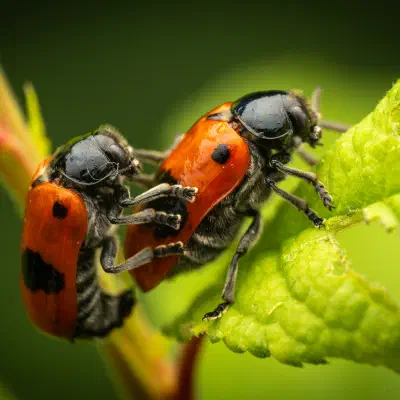
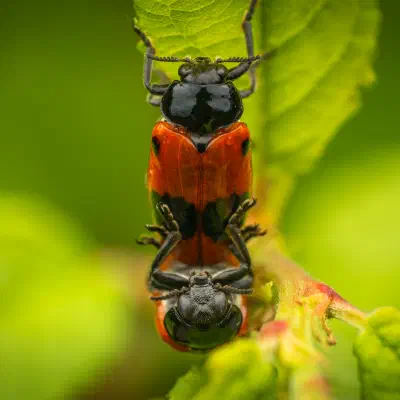
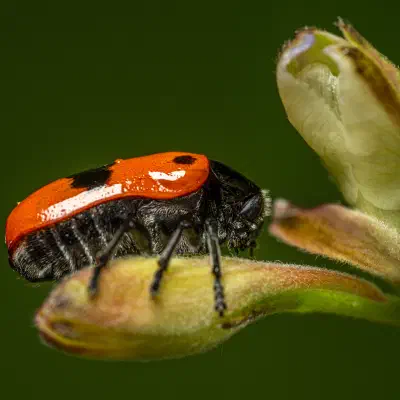
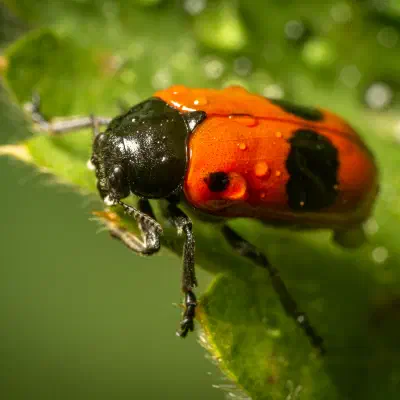
Clytra laeviuscula can reach a length of 7.5–11.5 millimetres (0.30–0.45 in) and a width of about 4 millimetres (0.16 in). These beetles have elongated bodies and shiny red-orange elytra with four black spots, two larger around the center of the elytra and two smaller on the shoulders. The prothorax is black and shiny. The head and legs are black, as well as the antennae that are quite short. Clytra laeviuscula can be distinguished from ladybirds (family Coccinellidae) by its more elongated form and by its tarsi (ends of the legs) formed of five parts (three for ladybugs). This species is rather similar to Clytra quadripunctata.

Adults occurs frequently from May to August. They are phytophagous. They feed on leaves, flowers and pollen of deciduous trees, mainly of Quercus robur, Salix, Populus, Betula, Fraxinus excelsior, Fagus sylvatica, Dorycnium, Prunus, Ulmus and Corylus avellana. They feed also on pollen of Rosa canina, Polygonum bistorta and Leucanthemum vulgare. Clytra laeviuscula has a special relationship with ants. The females wrap each egg with their hind legs in a ball of about 2 mm of excrements/feces and leaves it in the vicinity of an anthill. The eggs are taken to the nest by ants, where the larvae made a kind of tube that serves to protect them from ants. They feed on the waste and other detritus left by the ants, on their eggs and on their larvae. The adults usually emerge after about two weeks. The larval cycle lasts about two years.
WYDZIAŁ NAUK BIOLOGICZNYCH Insektenbox (in German)

This article uses material from the Wikipedia article Clytra laeviuscula the free encyclopedia Wikipedia which is released under Creative Commons Attribution-ShareAlike 4.0 International License). On Wikipedia a list of authors is available.
This is not intended to be a dry lexicon. Personal stories and sensitive articles form the framework for our pictures: „Explained as easy as pie — The biggest threats to bees“
Bees are essential for pollinating many plants and face significant threats from parasites, diseases, pesticides, and environmental changes.