Cabbage seed Weevil (lat. Ceutorhynchus obstrictus)

Cabbage seed Weevil
Scroll to read on

Ceutorhynchus obstrictus is a species of weevil native to Europe….

Cabbage seed Weevil – Distribution

Distribution

C. obstrictus is native to Europe and is also found in parts of Asia. Starting in the early 1930s it has been reported from North America (as Ceutorhynchus assimilis, a misidentification). It was first collected in Washington State and near Vancouver in western Canada. It is now more widely distributed in North America, especially in regions growing rapeseed (canola) where it is regarded as an important invasive pest.

Cabbage seed Weevil – Taxonomy

Taxonomy

There has been frequent confusion between the names Ceutorhynchus obstrictus (Marsham, 1802) and Ceutorhynchus assimilis (Paykull, 1792). Both are separate species and both are common in Europe, with C. obstrictus being on average slightly larger (typically 3–4 mm). The species found in North America has long been referred to as Ceutorhynchus assimilis, but it is now generally accepted that it is C. obstrictus and that C. assimilis does not occur in North America. Ceutorhynchus assimilis (Paykull, 1792) was originally described as Curculio assimilis by Paykull, a name which had been already assigned to another species by Fabricius in 1775. As a junior primary homonym, Paykull’s name should be invalid, but the International Commission on Zoological Nomenclature suppressed Fabricius’ name and preserved Paykull’s name. Ceutorhynchus assimilis (Paykull, 1792) is the type species of the genus Ceutorhynchus, it is sometimes referred to as Ceuthorrhynchus pleurostigma Stephens, 1829, a junior synonym.

Cabbage seed Weevil – Biology

Biology

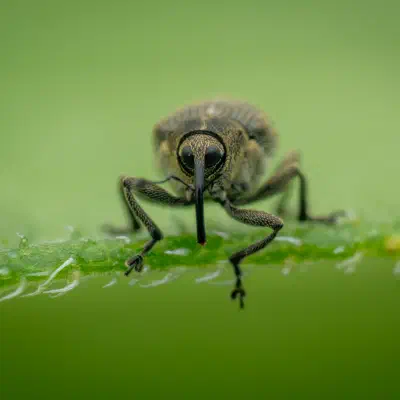
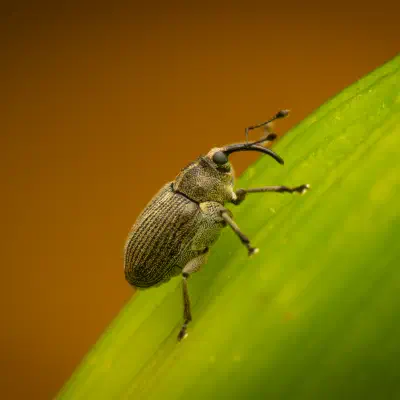
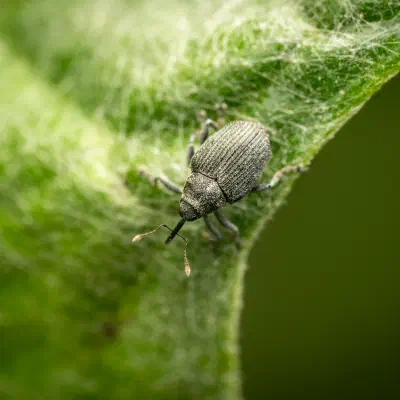
The adults of Ceutorhynchus obstrictus are 2.5–4 mm long, dark grey to black and covered with fine white scales. The snout is distinctly curved. Other features distinguishing it from related species include the morphology of the antennae, the hind femora and the tarsi. The adults emerge in spring from their hibernating sites in the ground when temperatures reach 10-15 °C. They feed on various Brassicaceae for several weeks until canola begins to flower. After migrating to canola fields, the adults feed again, mate and females start laying eggs into the developing seed pods. Eggs hatch after about a week. There are 3 larval instars which feed on the developing seeds inside the pods. The 3 larval stages develop over 2–4 weeks, during which time each larva feeds on and destroys up to 6 canola seeds. Upon completing their development, the larvae chew an exit hole through the wall of the seedpod, drop to the ground and pupate in the soil, about 1–2 cm below the surface. Pupation is completed after around 10 days. The young adults then emerge from the soil, disperse and feed. In autumn, they migrate to a hibernation site, for example a shelterbelt at the edge of the field, where they spent the winter in the soil or under litter on the ground. There is only one generation per year.

Cabbage seed Weevil – Damage and Management

Damage and Management

The adults feed on many species of crucifers, but females breed mainly on plants with large seedpods. Economic damage is highest for crops grown for seed production. In North America, infestations often exceed 25% of the rapeseed/canola pods having exit holes and yield losses on canola have been estimated at 5-30%. Management still relies mainly on the application of chemical pesticides, but progress has been made on alternative control methods. The latter include cultural control methods like planting a trap crop as strips around a large field where the weevils in the strips are killed with insecticides. Alternatively, crop rotation and planting weevil-resistant cultivars can be used. In Europe many natural enemies like parasitoids and predators of C. obstrictus are known, but in North America, relatively few efforts have been directed at classical biological control, that is the collection of suitable strains of parasitoids and predators in Europe and their release in North America. There is a need to revive these efforts.

Ancestry graph

Arthropods Insects Beetles True Weevils acorn weevil Black Vine Weevil Cabbage seed Weevil Cabbage Stem Weevil Ceutorhynchus typhae garden figwort weevil Green Immigrant Leaf Weevil Nut Weevil Otiorhynchus carinatopunctatus Otiorhynchus pinastri Rhamphus Small Nettle Weevil

Copyright and source information

This project wouldn’t exist without Wikipedia and iNaturalist! As citizen scientists, we benefit enormously from the community’s shared knowledge. This article uses material from Wikipedia and iNaturalist. The images on this website are licensed under Attribution-NonCommercial-ShareAlike 4.0 International.

This article uses material from the Wikipedia article Ceutorhynchus obstrictus the free encyclopedia Wikipedia which is released under Creative Commons Attribution-ShareAlike 4.0 International License). On Wikipedia a list of authors is available.

This is not intended to be a dry lexicon. Personal stories and sensitive articles form the framework for our pictures: „Explained as easy as pie — Why small creatures have big differences“ This article is about the evolutionary adaptation that has led to the impressive diversity of arthropods — including insects, crustaceans, and arachnids.

Full post

Explained as easy as pie — Why small creatures have big differences

Cabbage seed Weevil – image 1
Cabbage seed Weevil – image 2
Cabbage seed Weevil – image 3
Cabbage seed Weevil – image 4
Cabbage seed Weevil – image 5
Cabbage seed Weevil – image 6
Cabbage seed Weevil – image 7
Cabbage seed Weevil – image 8
Cabbage seed Weevil – image 9
Cabbage seed Weevil – image 10
Cabbage seed Weevil – image 11