


Description
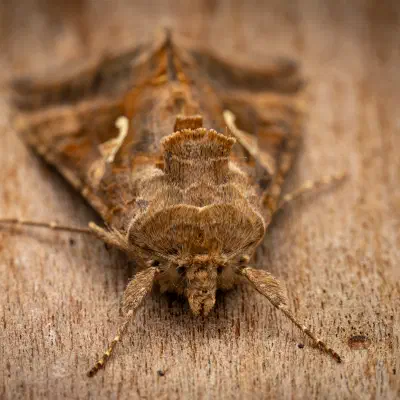
Adult: Most noctuid adults have wings with a variety of shades of browns, grays, and other varied shades and colourations but some subfamilies, such as Acronictinae and Agaristinae, are very colorful, especially those from tropical regions (e.g. Baorisa hieroglyphica). They are characterized by a structure in the metathorax called the nodular sclerite or epaulette, which separates the tympanum and the conjunctiva in the tympanal organ. It functions to keep parasites (Acari) out of the tympanal cavity. Another characteristic in this group is trifine hindwing venation, by reduction or absence of the second medial vein (M2). Markings present on the wings of noctuid adults can be helpful in distinguishing species. From the basal location to the outer edge (proximal to distal) on the forewing, there is a claviform (club-shaped) stigma, horizontally oriented with the thicker end closer to the wing’s outer edge, located posterior to a discal (round) stigma. These are followed distally by a reniform (kidney-shaped) stigma, which is typically oriented with its concave side facing the wing’s outer edge. It is often not possible to discern all of the stigmata on all specimens or species. Crossbands or crosslines may be present, oriented longitudinally from the leading to the trailing edge of the wing. Larva: Commonly green or brown; some species present bright colors, such as the camphorweed cucullia moth (Cucullia alfarata). Most are pudgy and smooth with rounded short heads and few setae, but there are some exceptions in some subfamilies (e.g. Acronictinae and Pantheinae). Pupa: The pupae most often range from shiny brown to dark brown. When they newly pupate they are bright brownish orange, but after a few days start to get darker. Eggs: Vary in colors, but all have a spherical shape.


