Hedychrum rutilans (lat. Hedychrum rutilans)

Hedychrum rutilans

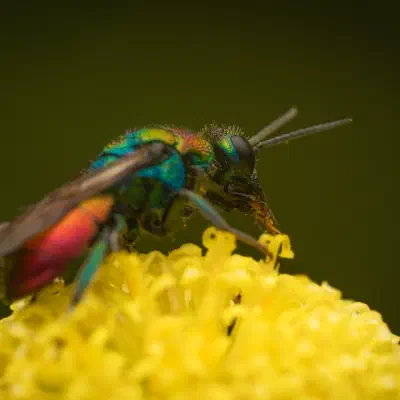
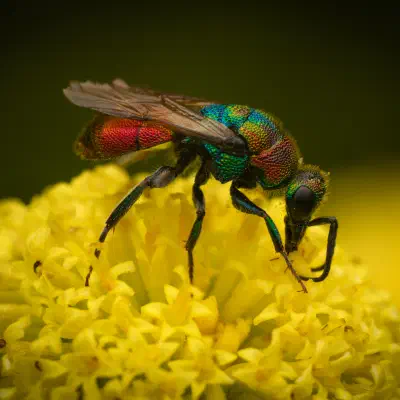
Hedychrum rutilans is a species of cuckoo wasps (insects in the family Chrysididae). The species occurs primarily in Austria, Italy, Bulgaria, Greece, France, Poland, Portugal, Spain, Switzerland and in North Africa. The head and thorax are metallic green with red spots, while the abdomen is red. The color is more green and partially golden in the male and more extensively golden-red in the female. The body is somewhat hairy.

Hedychrum rutilans – Biology

Biology

Hedychrum rutilans is a cleptoparasite and parasitoid of larvae of beewolves (Philanthus triangulum and Philanthus coronatus). The female cuckoo wasp lays its eggs on the paralyzed honeybee workers serving as provisions for the beewolf larvae, placed by the female beewolf in its brood cells. The cuckoo wasp larvae feed on the honeybees and on the larvae of the beewolf. Adults grow up to 4–10 mm (0.16–0.39 in) long and can be encountered from late June to September, often feeding on flowers of Mentha species, Achillea millefolium and Euphorbia paralias, but also on honeydew or various exudates. They prefer sandy and warm habitats.


Subspecies

Hedychrum rutilans var. rutilans Dahlbom, 1854 Hedychrum rutilans var. subparvulum Linsenmaier, 196 Hedychrum rutilans var. viridiauratum Mocsáry, 1889 Hedychrum rutilans var. viridiaureum Tournier, 1877

Strohm, Erhard; Kroiss, Johannes; Herzner, Gudrun; Laurien-Kehnen, Claudia; Boland, Wilhelm; Schreier, Peter; Schmitt, Thomas (2008). “A cuckoo in wolves’ clothing? Chemical mimicry in a specialized cuckoo wasp of the European beewolf (Hymenoptera, Chrysididae and Crabronidae)”. Frontiers in Zoology. 5: 2. doi:10.1186/1742-9994-5-2. PMC 2262889. PMID 18190702.

Copyright and source information

This project wouldn’t exist without Wikipedia and iNaturalist! As citizen scientists, we benefit enormously from the community’s shared knowledge. This article uses material from Wikipedia and iNaturalist. The images on this website are licensed under Attribution-NonCommercial-ShareAlike 4.0 International.

This article uses material from the Wikipedia article Hedychrum rutilans the free encyclopedia Wikipedia which is released under Creative Commons Attribution-ShareAlike 4.0 International License). On Wikipedia a list of authors is available.

This is not intended to be a dry lexicon. Personal stories and sensitive articles form the framework for our pictures: „The last refuge“ In a world suffering from extreme heat, Mario, the mite, discovers a legendary natural refuge that promises protection and cooling. His journey underlines the urgent need to secure sustainable habitats for all species.

Full post

The last refuge

Hedychrum rutilans – image 1
Hedychrum rutilans – image 2