Morphology
In the adult butterflies, the first pair of legs is small or reduced, giving the family the other names of four-footed or brush-footed butterflies. The caterpillars are hairy or spiky with projections on the head, and the chrysalids have shiny spots.
The trait for which these butterflies are most known is the use of only four legs; the reason their forelegs have become vestigial is not yet completely clear. Some suggest the forelegs are used to amplify the sense of smell, because some species possess a brush-like set of soft hair called setae, which has led researchers to believe the forelegs are used to improve signaling and communication between the species, while standing in the other four. This ability proves useful in terms of reproduction and the overall health of the species, and it is the leading theory so far.
The forewings have the submedial vein (vein 1) unbranched and in one subfamily forked near the base; the medial vein has three branches, veins 2, 3, and 4; veins 5 and 6 arise from the points of junction of the discocellulars; the subcostal vein and its continuation beyond the apex of cell, vein 7, has never more than four branches, veins 8–11; 8 and 9 always arise from vein 7, 10, and 11 sometimes from vein 7 but more often free, i.e., given off by the subcostal vein before apex of the cell.
The hindwings have internal (1a) and precostal veins. The cell in both wings is closed or open, often closed in the fore, open in the hindwing. The dorsal margin of the hindwing is channelled to receive the abdomen in many of the forms.
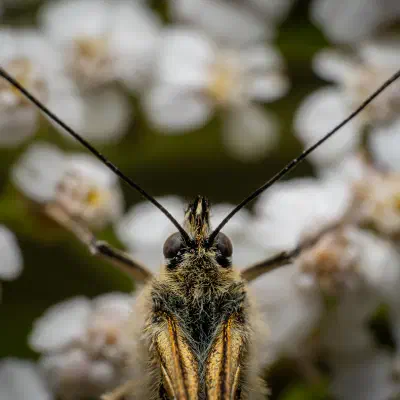
The antennae always have two grooves on the underside; the club is variable in shape. Throughout the family, the front pair of legs in the male, and with three exceptions (Libythea, Pseudergolis, and Calinaga) in the female also, is reduced in size and functionally impotent; in some, the atrophy of the forelegs is considerable, e.g., the Danainae and Satyrinae. In many of the forms of these subfamilies, the forelegs are kept pressed against the underside of the thorax, and are in the male often very inconspicuous.