


Description
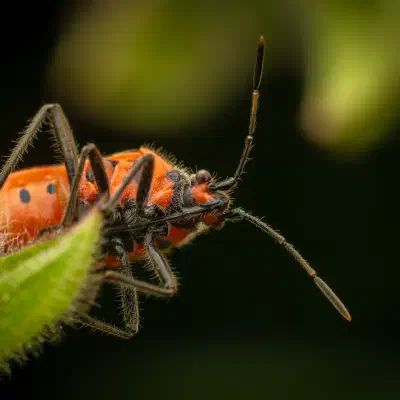
The membrane of the forewing has one or two cells from which about 7-8 branching veins emerge that may have branches that fuse together (anastomose) while the main veins reach the margins of the wing. They have three tarsal segments. They can be very difficult to separate from some members of the family Largidae, which also share some of these characters and belong to the same superfamily. Largids tend to have the edge of the pronotum (the top of the first thoracic segment) rounded, but the taxonomic feature for separating them is the found only in females. Female largids have the sixth visible (actually the seventh) abdominal segment appearing to be split in the middle, whereas it is undivided in female pyrrhocorids. A few bugs in the family Rhopalidae have similar colors (e.g., Corizus hyoscyami) but they have ocelli, as do lygaeids. The scutellum is small and triangular. The antennae are made up of four segments, with the second segment longer than the third. The beak-like mouthpart, or rostrum, has four segments, and its tip reaches at least the base of the middle pair of legs. Some species have the wing reduced so that the abdomen is visible from above. More detailed distinguishing features that are usually visible only under a microscope, include a much reduced scent gland opening on the mid-thoracic segment. There are three sensory hairs or trichobothria on the abdominal segments 3 to 6 and two such hairs on the seventh segment. The genus Myrmoplasta is found in the African and Oriental regions and is somewhat unusual in having highly reduced wings and appearing ant-like or myrmecomorphic. Males and females differ in their foreleg morphology, although such sexual dimorphism is also found in a few other genera.


