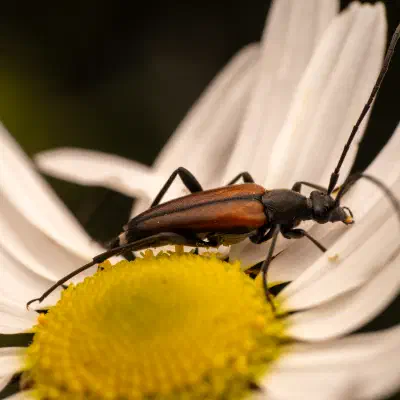
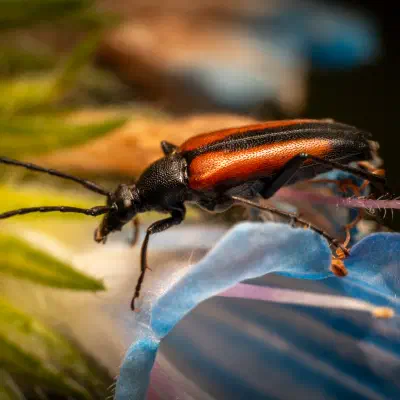
Black-striped Longhorn Beetle (lat. Stenurella melanura)

Black-striped Longhorn Beetle
Scroll to read on

Stenurella melanura is a beetle species of flower longhorns belonging to the family Cerambycidae, subfamily Lepturinae.

Black-striped Longhorn Beetle – Subspecies and varietas

Subspecies and varietas

Subspecies and varietas include:

Stenurella melanura melanura (Linnaeus, 1758) Stenurella melanura pamphiliae Rapuzzi & Sama, 2009 inq. Stenurella melanura samai Rapuzzi, 1995 inq. Stenurella melanura var. georgiana (Pic, 1891) Stenurella melanura var. latesuturata (Pic, 1891) Stenurella melanura var. melanurella (Reitter, 1901) Stenurella melanura var. rubellata (Reitter, 1901)

Black-striped Longhorn Beetle – Distribution

Distribution

This beetle is widespread in most of Europe, in the eastern Palearctic realm, in the Oriental realm, and in the Near East. It is present in Portugal, Spain, France, Belgium, the Netherlands, Switzerland, Italy, Germany, Austria, Great Britain, Denmark, Sweden, Norway, Finland, Poland, Czech Republic, Slovakia, Hungary, Slovenia, Croatia, Serbia, Albania, Romania, Bulgaria, Greece, Turkey, Russia, Kazakhstan and Mongolia.

Black-striped Longhorn Beetle – Habitat

Habitat

These beetles inhabit sunny forest edges, mixed coniferous forests, spruce pine forests and alpine and mountain pastures.

Black-striped Longhorn Beetle – Description

Description

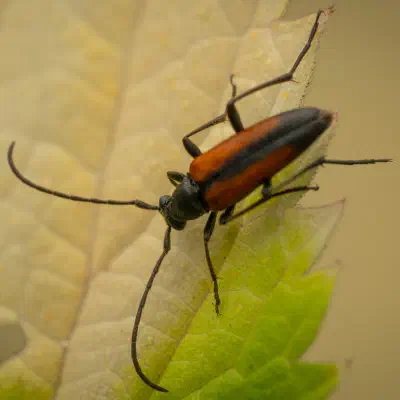
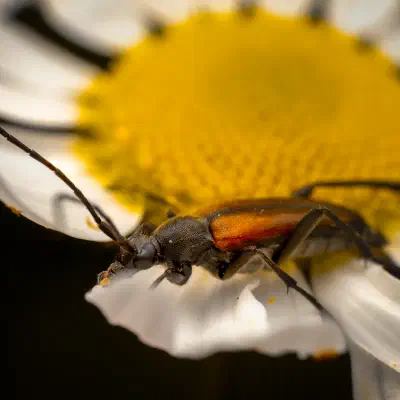
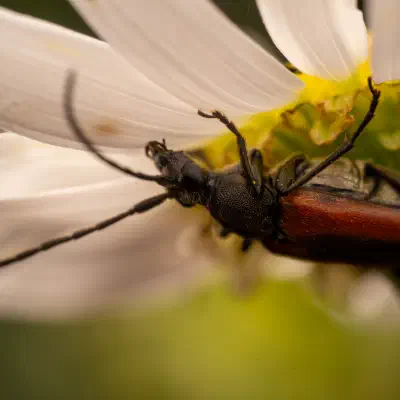
Stenurella melanura can reach a length of 6–10 millimetres (0.24–0.39 in). This beetle has a very narrow and rather long body. The antennae are about as long as the body. The head, pronotum and abdomen are black. The elytra are yellow-brown in males, with a black colored tip. In the females the elytra are reddish. The elytral suture is often black-colored, especially in the females, while the slender males have a darker tip and the black drawing is somewhat less pronounced.

Black-striped Longhorn Beetle – Biology

Biology

Both females and males can mate several times, and the males often remain on the female to prevent her from interacting with other males. Larvae develop in rotten wood of deciduous and coniferous trees, especially Castanea sativa. Adults can be encountered from May through September, completing their life cycle in two years. They are very common flower-visitors, especially Apiaceae species, feeding on pollen and the nectar.

InvertebrateIreland Online Longhorn Beetle of Japan Insektenbox

Ancestry graph

Arthropods Insects Beetles Longhorn Beetles Black-striped Longhorn Beetle common grammoptera Fairy-ring Longhorn Beetle Paracorymbia maculicornis Red Pine Longhorn Beetle small black longhorn beetle speckled longhorn beetle Spotted Longhorn Beetle spruce shortwing beetle Tanbark Borer variable longhorn beetle

Copyright and source information

This project wouldn’t exist without Wikipedia and iNaturalist! As citizen scientists, we benefit enormously from the community’s shared knowledge. This article uses material from Wikipedia and iNaturalist. The images on this website are licensed under Attribution-NonCommercial-ShareAlike 4.0 International.

This article uses material from the Wikipedia article Stenurella melanura the free encyclopedia Wikipedia which is released under Creative Commons Attribution-ShareAlike 4.0 International License). On Wikipedia a list of authors is available.

This is not intended to be a dry lexicon. Personal stories and sensitive articles form the framework for our pictures: „A song in rustling leaves“ To help us understand his world, a eurasian running crab spider has composed a brief poem.

Full post

A song in rustling leaves

Black-striped Longhorn Beetle – image 1
Black-striped Longhorn Beetle – image 2
Black-striped Longhorn Beetle – image 3
Black-striped Longhorn Beetle – image 4
Black-striped Longhorn Beetle – image 5
Black-striped Longhorn Beetle – image 6