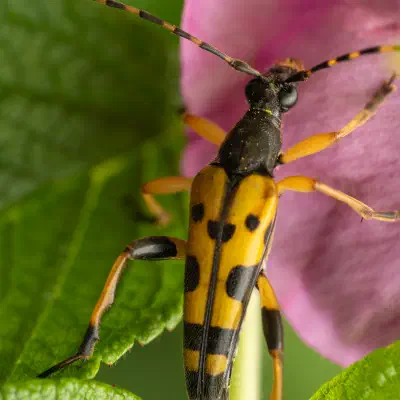
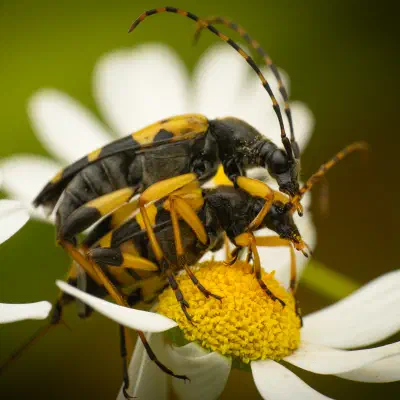
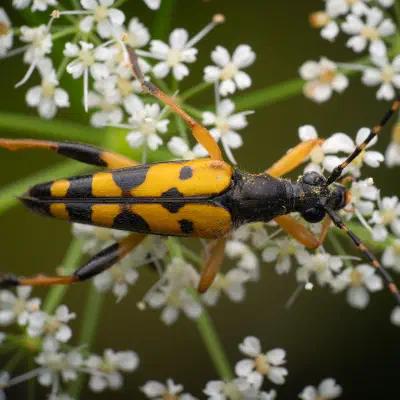
Spotted Longhorn Beetle (lat. Rutpela maculata)

Spotted Longhorn Beetle

Rutpela maculata, the Spotted Longhorn, is a beetle species of flower longhorns belonging to the family Cerambycidae, subfamily Lepturinae.

Spotted Longhorn Beetle – Varieties

Varieties

Varieties within this species include:

Rutpela maculata var. calcarata Olivier, 1790 Rutpela maculata var. maculipes Podaný, 1950 Rutpela maculata var. nigricornis (Stierlin, 1864) Rutpela maculata var. seminotata Kaufman, 1947 Rutpela maculata var. subbinotata Podaný Rutpela maculata var. subsinuata Depoli Rutpela maculata var. undulata (Mulsant, 1839) Rutpela maculata var. subexternepunctata Podaný Rutpela maculata var. parumnotata Podaný Rutpela maculata var. subspinosa Fabricius, 1792 Rutpela maculata var. subundulata Depoli, 1926 Rutpela maculata var. subdisconotata Podaný Rutpela maculata var. sinuata Fabricius, 1792

Spotted Longhorn Beetle – Distribution

Distribution

This beetle is widespread in most of Europe, in the eastern Palearctic realm, and in the Near East (Albania, Austria, Belgium, Bulgaria, Corsica, Croatia, Czech Republic, Denmark, Finland, France, Germany, Greece, Hungary, Italy, Luxembourg, Netherlands, Norway, Poland, Portugal, Romania, Russia, Sardinia, Serbia, Sicily, Slovakia, Slovenia, Spain, Sweden, Switzerland, Syria, Turkey, and the United Kingdom).

Spotted Longhorn Beetle – Description

Description

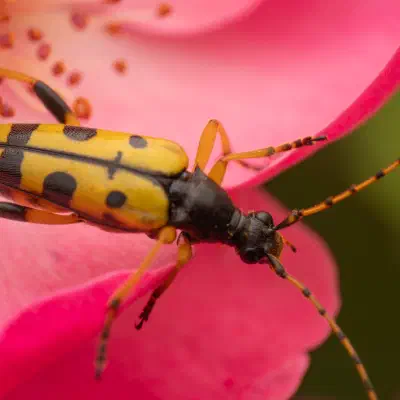
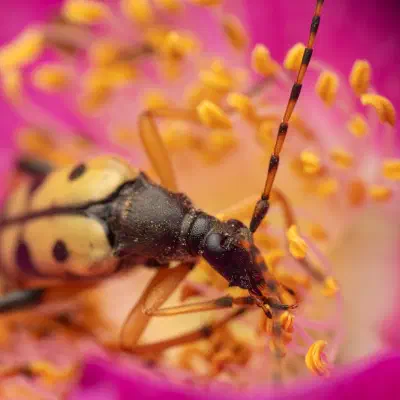
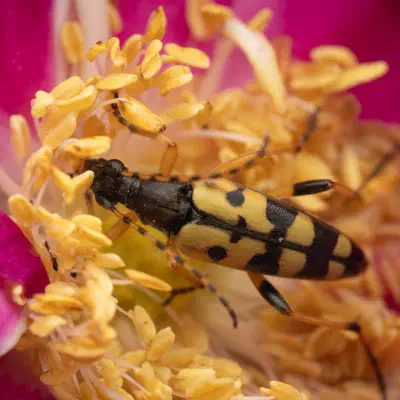
The adults grow up to 13–20 millimetres (0.51–0.79 in). The head and pronotum are dark-brown, while elytra are yellowish, with black dots and stripes, rough imitations of wasps, which probably gives them some protection from birds.

Spotted Longhorn Beetle – Biology

Biology

The species completes its life cycle in two to three years, spending most of their lives as larvae. The adults can be encountered from May to August; they are short-lived, only living for two to four weeks. They are very common flower-visitors, especially Apiaceae species, feeding on pollen and the nectar. The larvae are polyphagous in the wood of deciduous trees, mainly feeding on Corylus avellana, Fagus sylvatica, Castanea sativa and Ostrya carpinifolia, as well as on Quercus, Carpinus, Salix, Alnus, Populus and Betula species.

Spotted Longhorn Beetle – See also

See also

Clytus arietis, another common wasp-mimicking longhorn beetle.

Cerambycoidea

Copyright and source information

This project wouldn’t exist without Wikipedia and iNaturalist! As citizen scientists, we benefit enormously from the community’s shared knowledge. This article uses material from Wikipedia and iNaturalist. The images on this website are licensed under Attribution-NonCommercial-ShareAlike 4.0 International.

This article uses material from the Wikipedia article Rutpela maculata the free encyclopedia Wikipedia which is released under Creative Commons Attribution-ShareAlike 4.0 International License). On Wikipedia a list of authors is available.

This is not intended to be a dry lexicon. Personal stories and sensitive articles form the framework for our pictures: „Death in the garden“ Otto, the earwig, experiences an environment that is becoming increasingly dangerous due to the use of neonicotinoids and confronts the deadly consequences of these insecticides for himself and other insects.

Full post

Death in the garden

Spotted Longhorn Beetle – image 1
Spotted Longhorn Beetle – image 2
Spotted Longhorn Beetle – image 3
Spotted Longhorn Beetle – image 4
Spotted Longhorn Beetle – image 5
Spotted Longhorn Beetle – image 6