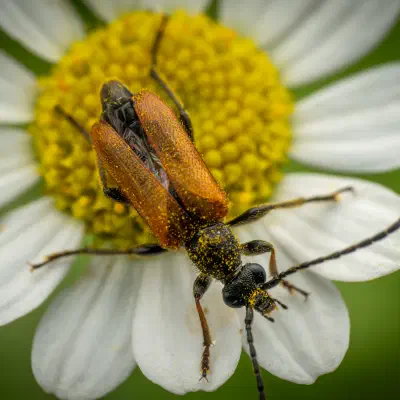
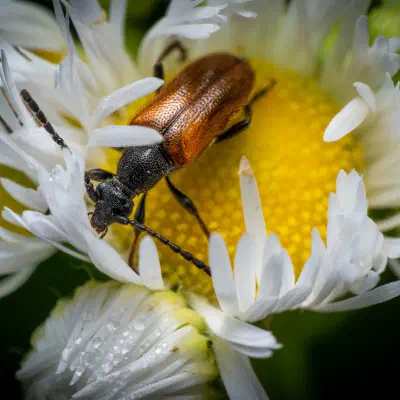
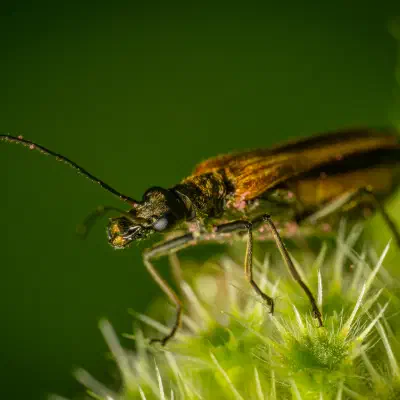
Fairy-ring Longhorn Beetle (lat. Pseudovadonia livida)

Fairy-ring Longhorn Beetle

Pseudovadonia livida, the fairy-ring longhorn beetle, is a beetle species of flower longhorns belonging to the family Cerambycidae, subfamily Lepturinae….

Fairy-ring Longhorn Beetle – Subspecies

Subspecies

Subspecies include:

Pseudovadonia livida bicarinata (Arnold, 1869) Pseudovadonia livida desbrochersi (Pic, 1891) Pseudovadonia livida hatayensis Özdikmen, 2015 Pseudovadonia livida livida (Fabricius, 1776) Pseudovadonia livida pecta (J. Daniel & K. Daniel, 1891) Pseudovadonia livida setosa Danilevsky, 2013

Fairy-ring Longhorn Beetle – Distribution

Distribution

This beetle is widespread in most of Europe, in the eastern Palearctic realm, and in the Near East (Armenia, Azerbaijan, Belarus, Belgium, Bulgaria, China, Czech Republic (Bohemia, Moravia), Estonia, France, Georgia, Germany, Greece, Iran, Italy, Kazakhstan, Kyrgyzstan, Latvia, Lithuania, Luxembourg, Moldova, Netherlands, Poland, Portugal, Romania, Russia, Sicily, Slovakia, Spain, Turkey, Ukraine, and the United Kingdom).

Fairy-ring Longhorn Beetle – Habitat

Habitat

This species mainly inhabits pine forests, but they are also present in deciduous trees (Quercus and Castanea species).

Fairy-ring Longhorn Beetle – Description

Description

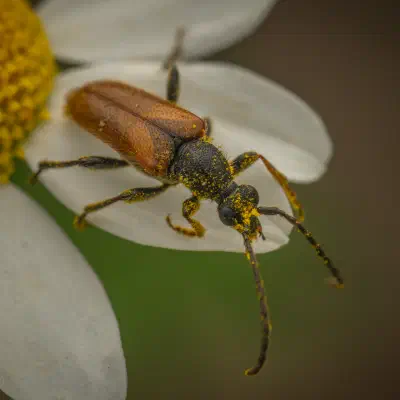
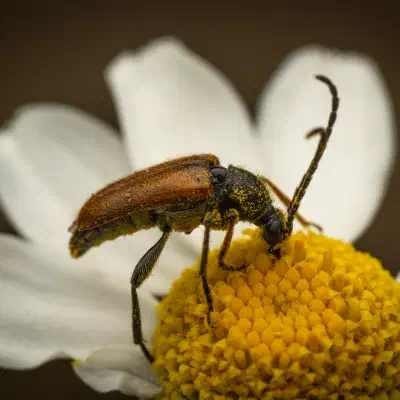
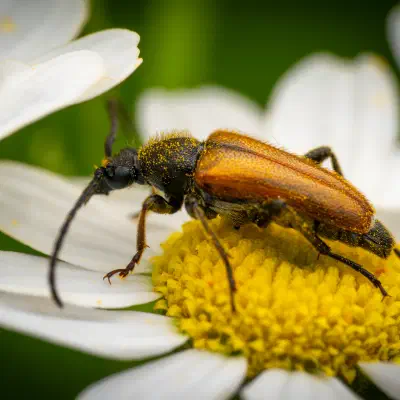
The adults of Pseudovadonia livida grow up to 5–9 millimetres (0.20–0.35 in). These small beetles are robust and have a broad head with large eyes, dense puncturation and erect pubescence. The antennae are black and robust, slightly shorter than the body. Pronotum is quadrate and shiny black, with shallow puncturation on the surface. Also the scutellum is shining black. Elytra are reddish-brown with darker suture. Shoulders are much wider than the base of the pronotum. They are covered with fine semi-erect golden hair.

Fairy-ring Longhorn Beetle – Biology

Biology

Adults can be encountered from May through September, completing their life cycle in two years. They are very common flower-visitors, especially Apiaceae species, feeding on pollen and the nectar. Larvae do not develop in dead wood, as usual in many species of Cerambycidae, but in humus infested by fungus Marasmius oreades, feeding on mycelium.

Fairy-ring Longhorn Beetle – References

References

Ehnström, B. og Holmer, M. 2007. Nationalnyckeln till Sveriges flora och fauna. Skalbaggar: Långhorningar. Coleoptera: Cerambycidae. ArtDatabanken SLU, Uppsala. 298 sider. ISBN 978-91-88506-62-7

Coleoptera and Coleopterologists

Copyright and source information

This project wouldn’t exist without Wikipedia and iNaturalist! As citizen scientists, we benefit enormously from the community’s shared knowledge. This article uses material from Wikipedia and iNaturalist. The images on this website are licensed under Attribution-NonCommercial-ShareAlike 4.0 International.

This article uses material from the Wikipedia article Pseudovadonia livida the free encyclopedia Wikipedia which is released under Creative Commons Attribution-ShareAlike 4.0 International License). On Wikipedia a list of authors is available.

This is not intended to be a dry lexicon. Personal stories and sensitive articles form the framework for our pictures: „The Spanish crane fly“ Is Bavaria the new Barcelona? Mio, the mosquito, experiences climate zones gone astray.

Full post

The Spanish crane fly

Fairy-ring Longhorn Beetle – image 1
Fairy-ring Longhorn Beetle – image 2
Fairy-ring Longhorn Beetle – image 3
Fairy-ring Longhorn Beetle – image 4
Fairy-ring Longhorn Beetle – image 5
Fairy-ring Longhorn Beetle – image 6
Fairy-ring Longhorn Beetle – image 7