Distribution and habitat
This species is present in most of Europe, the Afrotropical realm, the eastern Palearctic realm, the Near East and North Africa, the Indomalayan realm, and the Nearctic realm. These flies usually inhabit meadows.

Stomorhina lunata is a species of fly in the family Calliphoridae, often misidentified because of the unusual band pattern in the abdomen, typical of hoverflies. S. lunata is an important egg predator of some major African agricultural pests, the South African Brown locust (Locustana pardalina), the more widespread Desert locust (Schistocerca gregaria), and the migratory locust (Locustana migratoria).
This species is present in most of Europe, the Afrotropical realm, the eastern Palearctic realm, the Near East and North Africa, the Indomalayan realm, and the Nearctic realm. These flies usually inhabit meadows.

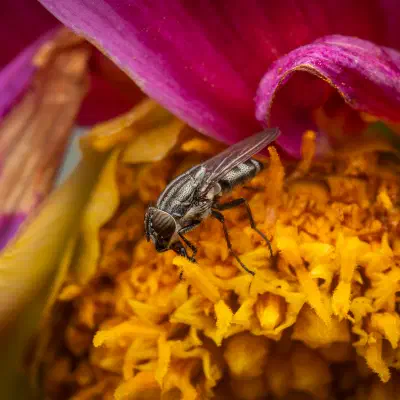
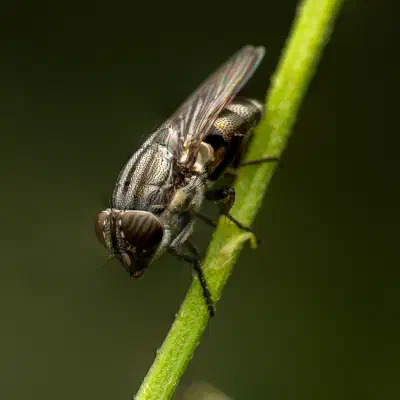
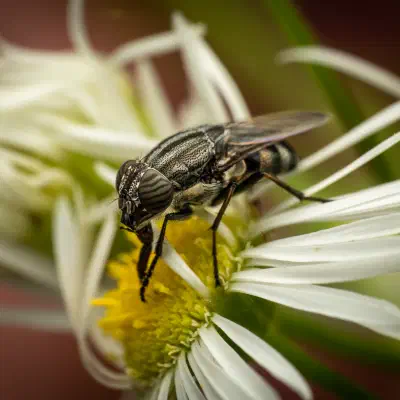
Stomorhina lunata can reach a length of 5–9 millimetres (0.20–0.35 in) and a wingspan of 13–16 millimetres (0.51–0.63 in). These distinctive, medium-sized blowflies are rather similar to the house flies, but they have a characteristic prominent proboscis, a longitudinally striped thorax and an abdomen with yellow and black bands. Males have large orange patches on the sides of tergites 3 and 4, while females only show grey dust patches. This distinctively marked species is often misidentified because of the unusual band pattern in the abdomen, typical of hoverflies.
Stomorhina lunata is an important egg predator of some major African agricultural pests, the South African brown locust (Locustana pardalina), the more widespread desert locust (Schistocerca gregaria), and the migratory locust (Locustana migratoria). Adults are migratory and are present from July to October. They can usually be found feeding on nectar and pollen of umbellifer flowers (Apiaceae) and of Asteraceae species (mainly Scorzoneroides autumnalis, Tanacetum vulgare, Anthriscus sylvestris, Erysimum cheiranthoides, Filipendula ulmaria).
Data related to Stomorhina lunata at Wikispecies Media related to Stomorhina lunata at Wikimedia Commons Eakringbirds Nature Spot

This article uses material from the Wikipedia article Stomorhina lunata the free encyclopedia Wikipedia which is released under Creative Commons Attribution-ShareAlike 4.0 International License). On Wikipedia a list of authors is available.
This is not intended to be a dry lexicon. Personal stories and sensitive articles form the framework for our pictures: „The last refuge“
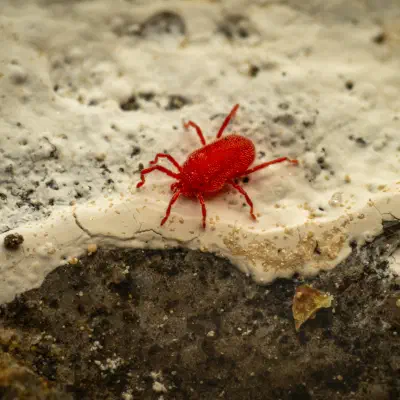
In a world suffering from extreme heat, Mario, the mite, discovers a legendary natural refuge that promises protection and cooling. His journey underlines the urgent need to secure sustainable habitats for all species.