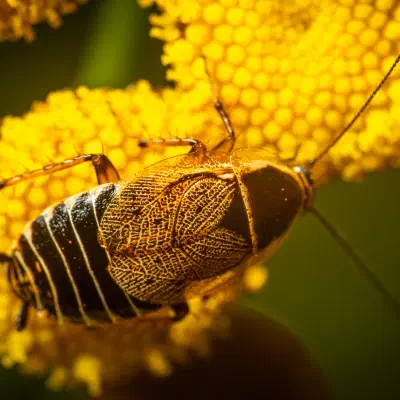
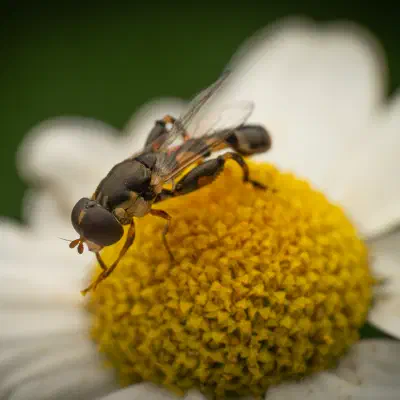
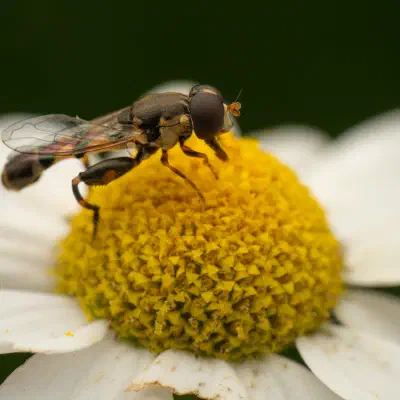
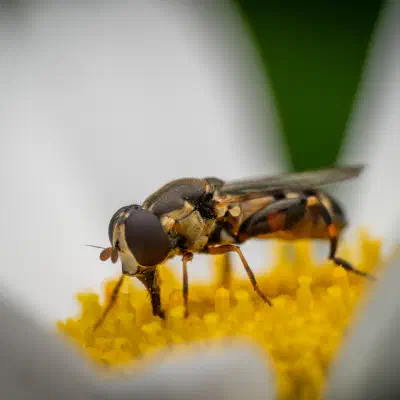
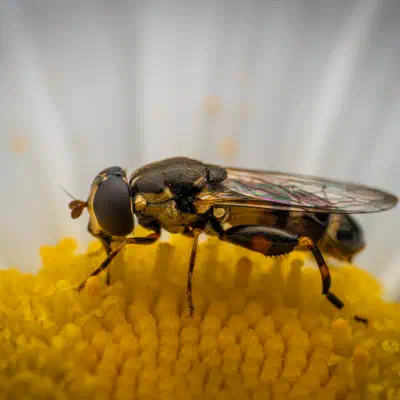
Thick-legged Hover Fly (lat. Syritta pipiens)

Thick-legged Hover Fly
Scroll to read on

Syritta pipiens is a common species of European hover fly. It is sometimes called the thick-legged hoverfly, from its distinctive broad hind femora. They are fast nimble fliers, and the larvae feed in rotting organic matter.

Thick-legged Hover Fly – Morphology

Morphology

The species Syritta pipiens is within the family of Syrphidae, commonly called hover or flower flies. Syrphidae is one of the largest families within the Diptera order and contains about 6,000 known species widely distributed around the world. They are distinctive flies that are often found on flowers, where the adult males primarily feed on nectar and adult females eat protein-rich pollen to produce eggs. The name “thick-legged hoverfly” comes from the fly’s distinctively broad femora. A thick-legged hoverfly has a wing length ranging between 4.25–7 mm (0.167–0.276 in) and a body length between 6.5–9 mm (0.26–0.35 in). Both sexes have apical third of metafemur and a row of spines along the ventral edge. Another distinctive morphological feature is the pair of small white wedge-shaped spots on the fly’s thorax directly behind its head. The male femur 3 is strongly thickened. It has no basal protuberance. Tergites 2 and 3 have small, pale marks. Female tergites have similar markings, with ocellar triangle bluish-black, metallic sheen. Side margins of thorax dorsum are dusted. Side and hind margins of tergite 4 are not dusted. See references for determination. The eyes of Syritta pipiens span over almost the entirety of their heads. Both sexes have similarly sized hemispherical heads, with a diameter of 2 mm. However, the eyes differ among the two sexes in two ways. First, males have holoptic eyes, meaning that their eyes meet in the front, which is a feature common in male syrphid flies. Second, males have enlarged facets (fovea) between the clypeus and ocellar triangle, which are absent in females.

Thick-legged Hover Fly – Taxonomy

Taxonomy

The family Syrphidae divides into four subfamilies: Eristalinae, Microdontinae, Pipizinae, and Syrphinae. Syritta pipiens belong to the subfamily Eristalinae, closely related to the well-known dronefly, Eristalis tenax.

Thick-legged Hover Fly – Distribution and habitat

Distribution and habitat

Syritta pipiens have been found across North American as well as Asia since their first introduction from Europe in 1800s. The species is cosmopolitan except for the Afrotropical realm. It is found wherever there are flowers, as it feeds on and lives around flowers. It is also anthropophilic, occurring in farmland, suburban gardens, and urban parks. It is found in mid April to mid October in Ontario; in Europe, it flies from March to November, as most records show, but it is also likely that it flies all year round in southern European regions where it is warmer. At the larval stage, the species inhabits wetlands that are in proximity to bodies of freshwater such as lakes, ponds, rivers, ditches.

Thick-legged Hover Fly – Life history

Life history

Syritta pipiens goes through three adolescent stages – eggs, larvae, and puparia – followed by the fourth life stage of the adult. Larvae develop in moist and rotting organic matter, so different stages of the fly have been found variously in the manures of cows, horses, and guinea pigs, in human waste and decaying heaps of vegetable waste, and in garden compost.

Thick-legged Hover Fly – Food resources

Food resources

Larval forms of Syritta pipiens feed on decaying organic matter. Adult flies feed on the flowers of water-willow (Dianthera americana L.), white vervain (Verbena urticifolia L.), American pokeweed (Phytolacca decandra L.), and candyleaf (Stevia rebaudiana). They pollinate bluebell flowers (Campanula rotundifolia L.), which is a perennial herbaceous plant, with blue flowers.

List of flowers they also visit: Achillea, Allium, Aster, Calluna, Cardamine, Cirsium palustre, Convolvulus, Crataegus, Epilobium, Euphorbia, Galium, Jasione montana, Leontodon, Polygonum cuspidatum, Potentilla erecta, Prunus laurocerasus, Ranunculus, Rosa canina, Senecio jacobaea, Sorbus aucuparia, Tussilago.

Thick-legged Hover Fly – Relation to humans

Relation to humans

Flower flies (the family Syrphidae) are critical and one of the most common bio-control agents of plant pests because their larvae feed on aphids. As one of the exceptions, Syritta pipiens specializes in organic waste, leaving the predation to other members of the family. They are also recyclers of plant and animal debris, important pollinators a variety of common plants, as well as pests for certain ornamental plants. Because they play an important role in supporting the functionality of the environment, flower flies also serve as bio-indicators of environmental health, demonstrating the effects of climate change on pollinators. Their abundance is closely linked to agricultural landscapes and arable lands and is contingent upon the density of flowering plants available. Thus, landscape changes can very easily have an impact on the organism’s density, and result in further cascades of consequences.

Media related to Syritta pipiens at Wikimedia Commons External images Morphology of Diptera

Ancestry graph

Arthropods Insects Brachyceran Flies Hover Flies Common Drone Fly Common Globetail Eumerus Hornet Mimic Hover Fly Marmalade Hover Fly Narcissus Bulb Fly Pellucid Hover Fly Pipizella Tapered Drone Fly Thick-legged Hover Fly Trivittate Marsh Fly Variable Duskyface Fly Yellow-bowed Smoothwing Yellow-haired Sun Fly

Copyright and source information

This project wouldn’t exist without Wikipedia and iNaturalist! As citizen scientists, we benefit enormously from the community’s shared knowledge. This article uses material from Wikipedia and iNaturalist. The images on this website are licensed under Attribution-NonCommercial-ShareAlike 4.0 International.

This article uses material from the Wikipedia article Syritta pipiens the free encyclopedia Wikipedia which is released under Creative Commons Attribution-ShareAlike 4.0 International License). On Wikipedia a list of authors is available.

This is not intended to be a dry lexicon. Personal stories and sensitive articles form the framework for our pictures: „Night at the farmhouse“ The human world is exciting and Hugo's curiosity is simply too great, so every night he sets off on an adventure and risks everything.

Full post

Night at the farmhouse

Thick-legged Hover Fly – image 1
Thick-legged Hover Fly – image 2
Thick-legged Hover Fly – image 3
Thick-legged Hover Fly – image 4
Thick-legged Hover Fly – image 5
Thick-legged Hover Fly – image 6
Thick-legged Hover Fly – image 7